News & Drops
Why Limited-Edition Drops Sell Out in Minutes

Why Limited-Edition Drops Sell Out in Minutes comes down to more than simply having fewer products available. Limited drops combine scarcity, anticipation, social proof, exclusivity, competition, community identity, and carefully timed marketing into one high-pressure buying event.
For shoppers, that can turn an ordinary hoodie, sneaker, jacket, or collaboration into something that feels impossible to ignore. For brands, a successful drop can create attention that lasts far beyond the moment inventory reaches zero.
The concept is especially powerful in limited edition streetwear, where wearing something rare can communicate taste, knowledge, and membership in a particular culture.
Research supports the basic scarcity effect: people can place greater value on products when availability is perceived as limited. A 2022 meta-analysis covering 131 studies found that scarcity cues can increase perceived value and purchase intentions, although the effect depends on the type of scarcity and product.
So what actually happens between the announcement of a drop and the dreaded “Sold Out” message?

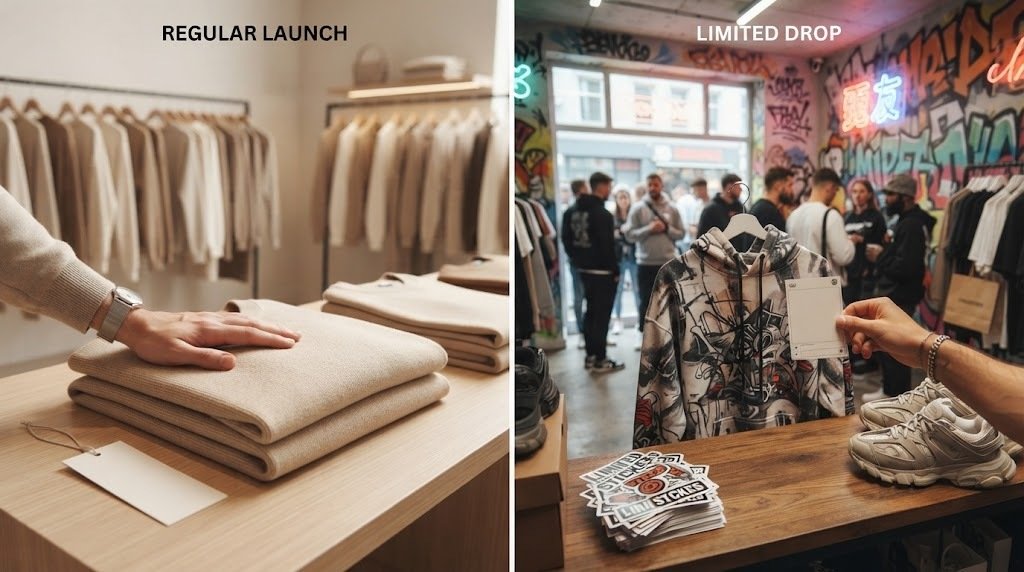
Why Limited-Edition Drops Sell Out So Quickly
The simplest explanation is supply and demand: when a large number of interested buyers compete for a deliberately small inventory, the available products can disappear almost immediately.
But scarcity alone is not enough.
A random product with only 50 units available will not necessarily sell out. The product needs some combination of desirability, brand credibility, cultural relevance, anticipation, and audience demand.
A useful way to understand the process is:
Desirable product + limited supply + anticipation + audience attention + urgency = high probability of a rapid sellout.
That formula is a synthesis of the recurring patterns seen across modern product-drop research and successful fashion launches.
The faster those factors build before launch day, the less time shoppers need to make a purchase decision.
Instead of asking, “Do I really need this?” buyers start asking, “How quickly can I get it?”
The Scarcity Psychology Behind Limited Drops
Scarcity is one of the strongest reasons limited drops create urgency.
The American Psychological Association’s definition of scarcity notes that people can assign greater value to resources, opportunities, or information perceived as limited or rare.
Robert Cialdini’s work on persuasion also identifies scarcity as a major influence principle: when people believe they may lose access to something, desire can increase.
Limited quantity creates competition
Consider two nearly identical streetwear hoodies.
Hoodie A: Available year-round in unlimited quantities.
Hoodie B: 500 units available at 10 a.m. and no guaranteed restock.
Even if Hoodie B is not objectively better, the purchasing situation is completely different.
The buyer knows other people want the same item. Every purchase made by someone else potentially reduces their chance of getting one.
That creates competition.
Research published in the Journal of Retailing and Consumer Services has found that purchase-priority competition can increase competitive arousal, particularly when consumers care about superiority, self-enhancement, and getting a product before others.
Scarcity makes the decision feel urgent
A normal product allows time for comparison.
A limited drop removes that luxury.
A shopper may normally spend two days comparing:
- Price
- Material
- Fit
- Reviews
- Alternatives
- Shipping
- Whether they actually need it
A limited drop can compress that decision into 30 seconds.
That is one reason a product can generate dramatically different behavior when the same item is presented as a permanent release versus a one-time release.
Why Hype and Anticipation Matter as Much as Scarcity
Scarcity gets attention, but anticipation often creates the emotional momentum that makes a drop explode.
Successful brands rarely announce a limited product five minutes before it becomes available and expect instant demand from nowhere.
They build a story first.
That can include:
- Teaser images
- Behind-the-scenes videos
- Close-up product shots
- Collaboration announcements
- Influencer previews
- Countdown posts
- Email notifications
- Early-access lists
- Sneak peeks
- Rumors and speculation
- Community discussions
The goal is to make the product feel important before it can be purchased.
Queue-it’s research on product drops describes anticipation psychology as one of the major forces behind drop culture. Its analysis also points to product drops functioning as entertainment and community events rather than ordinary retail transactions.
Anticipation changes how the product is remembered
This is an overlooked part of drop culture.
If you see a hoodie in a store and buy it immediately, the purchase may be forgettable.
If you spend two weeks watching teasers, discussing the release with friends, setting an alarm, entering a waiting room, and finally securing the hoodie, the purchase becomes an event.
The product now has a story attached to it.
That story can increase the emotional value of ownership.
This is particularly relevant to streetwear because fashion is not purely functional. Clothing can communicate identity, taste, belonging, and cultural awareness.
Why Social Media Makes Limited Edition Streetwear Even Stronger
Social media has changed the economics of scarcity.
Before digital platforms, a limited release might be discussed among local customers, magazine readers, or dedicated fashion communities.
Today, a single product image can circulate across TikTok, Instagram, Reddit, YouTube, X, Discord, and private group chats before the official release.
That creates a feedback loop:
Teaser → discussion → sharing → anticipation → demand → sellout → resale posts → more attention → next drop.
Shopify’s 2026 analysis highlights the connection between limited drops, social media, word of mouth, and modern shopping behavior.
The “I got it” effect
Social media does something else: it makes successful buyers visible.
Imagine 100,000 people want a limited sneaker and only 10,000 pairs are available.
After the release, the 10,000 successful buyers post:
- Unboxing videos
- Outfit photos
- Close-up product shots
- Fit checks
- Collection photos
- “I finally got them” posts
The people who missed the drop now see the product repeatedly.
Ironically, the product can become more desirable after it has sold out.
This creates another wave of demand around the next release.
Why Limited Drops Create FOMO
FOMO means fear of missing out.
In limited-edition fashion, FOMO is not simply fear of losing a product. It can also mean fear of losing the opportunity to participate in a cultural moment.
A shopper may think:
“If I don’t buy this now, I may never have another chance.”
That thought is powerful because the perceived future availability is uncertain.
A regular product says:
“You can buy this whenever you’re ready.”
A limited drop says:
“Decide before someone else does.”
That difference changes the psychological environment of the purchase.
Research into scarcity messaging has found that limited-quantity and social-competition cues can influence purchase intention, although the precise effect depends on the type of scarcity and the surrounding context.
Why Exclusivity Makes Buyers Want to Belong
Limited edition streetwear is often about more than owning clothing.
It can be about belonging to a group.
Supreme is a classic example of how product drops can become recurring cultural events. Other brands have adapted the same basic concept through collaborations, members-only releases, early access, and limited collections.
When an item is difficult to obtain, ownership can become a form of social signaling.
The customer is not just saying:
“I own this jacket.”
They may also be saying:
“I knew about this release, I understood its significance, and I managed to get one.”
That is particularly important in streetwear communities where knowledge of brands, collaborations, release dates, and past collections can be part of the culture.
How Brand Collaborations Make Drops Sell Out Faster
Collaborations combine audiences.
Imagine a streetwear label with 500,000 followers collaborating with a sneaker company that has 5 million followers.
The collaboration can expose the product to two communities simultaneously.
Collaborations can also create perceived uniqueness because the exact combination may never appear again.
Common collaboration formats include:
- Streetwear brand × sneaker brand
- Designer × artist
- Fashion label × musician
- Brand × celebrity
- Luxury label × sportswear company
- Streetwear brand × entertainment franchise
Queue-it identifies collaborations as one of the recurring formats associated with modern product drops.
The key is that the collaboration gives consumers a reason to care beyond the physical product itself.
Why Some Drops Sell Out in Minutes While Others Fail
Scarcity is not magic.
A limited quantity cannot manufacture genuine desire indefinitely.
Research published in the Journal of Retailing and Consumer Services shows that supply limitation can work differently depending on the underlying quality and appeal of the product. In other words, making an undesirable product scarce does not automatically make it desirable.
A successful drop usually combines several elements:
1. The product is genuinely desirable
The design, quality, collaboration, story, or brand reputation gives customers a reason to want it.
2. The audience already exists
A brand with an active community can create demand much more easily than an unknown company starting from zero.
3. The scarcity is believable
Consumers need to believe that the product really is difficult to obtain.
4. The timing is clear
A specific release date and time reduce uncertainty.
5. The brand builds anticipation
Customers should know what is coming and have enough time to become interested.
6. The buying experience works
A brilliant marketing campaign can still fail if the website crashes or bots purchase most of the inventory.
The Hidden Role of Bots and Resellers
One of the biggest differences between ordinary shopping and hyped drops is the presence of automated purchasing systems.
Bots can attempt to:
- Enter releases automatically
- Submit checkout forms rapidly
- Purchase multiple units
- Circumvent purchase limits
- Exploit weaknesses in checkout systems
Queue-it has documented cases where enormous numbers of automated or untrusted visitors attempted to participate in high-demand drops.
This creates a fairness problem.
A genuine customer may spend 20 minutes waiting for a product while an automated system attempts thousands of transactions.
For that reason, modern drop infrastructure can involve:
- CAPTCHA
- Rate limiting
- Purchase limits
- Account verification
- Virtual waiting rooms
- Bot detection
- Randomized queues
- Raffles
- Member-only access
The objective is not simply to sell every unit as quickly as possible. It is to make the buying process credible enough that customers continue trusting the brand.
Why Selling Out Too Fast Can Actually Hurt a Brand
This is one of the most important gaps in many discussions about limited drops.
A sellout is usually presented as an automatic success.
It isn’t always.
If thousands of genuine customers repeatedly miss out because inventory is dramatically below demand, frustration can replace excitement.
Recent research in the Journal of Retailing found that extremely limited quantities can sometimes reduce perceptions of retailer sincerity, particularly when the available quantity is lower than consumers expected.
Another 2025 study found that immediate sellouts of some hedonic limited editions can actually reduce perceived hedonic value and repurchase intentions, suggesting that “sold out instantly” is not universally positive.
That creates a useful distinction:
A fast sellout proves demand. It does not automatically prove a good customer experience.
A brand should ask:
- Were genuine customers able to participate?
- Did bots dominate the release?
- Was inventory too low?
- Did customers understand the rules?
- Was the checkout reliable?
- Was the product available through a fair system?
- Will disappointed customers return for the next drop?
The Resale Market Makes Scarcity Even More Powerful
Once a product sells out, a second market often appears.
Collectors and resellers may list the item on secondary platforms at higher prices.
This can reinforce the original perception that the product is valuable.
For example:
Retail price: $180
Product sells out: 3 minutes
Secondary-market listing: $350
Social media posts: Hundreds or thousands
A shopper who originally ignored the product may now perceive it differently.
The resale price becomes a form of social proof.
However, resale prices are not a perfect measure of actual product value. They can reflect temporary demand, limited supply, speculation, seller expectations, and market volatility.
For shoppers, that means a high resale price should not automatically be interpreted as evidence that the original purchase was financially worthwhile.
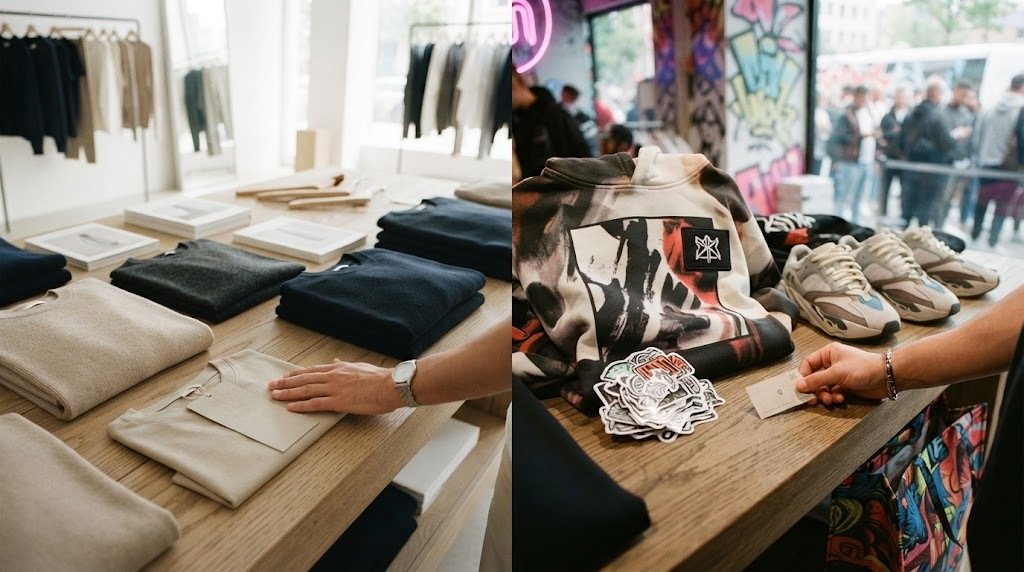
Limited Drops vs. Regular Product Launches
A product launch normally introduces an item that the company expects to sell over an extended period.
A limited drop emphasizes restricted availability, a short purchasing window, or both.
| Regular Launch | Limited Drop |
|---|---|
| Long availability | Short or restricted availability |
| Focus on sustained sales | Focus on concentrated demand |
| Inventory can be replenished | Restock may be uncertain |
| Lower urgency | High urgency |
| Product-first messaging | Event-first messaging |
| Broad accessibility | Exclusivity is often central |
Queue-it and Shopify both distinguish product drops from conventional launches by their emphasis on scarcity, timing, and limited availability.
Limited Drops vs. Flash Sales
These concepts are related but not identical.
A flash sale generally uses a temporary discount to encourage customers to buy quickly.
A limited drop usually creates urgency through product availability rather than a large price reduction.
For example:
Flash sale:
“30% off all hoodies until midnight.”
Limited drop:
“300 numbered hoodies available Friday at 10 a.m.”
The first strategy makes the price scarce.
The second makes the product scarce.
Shopify specifically identifies limited drops as short-run or limited-quantity releases, while flash sales typically focus on time-limited discounts.
How Brands Turn a Drop Into a Community Event
The strongest drop strategies do not end when the checkout closes.
They create a cycle:
- Tease the product
- Build anticipation
- Release the product
- Create competition
- Sell out
- Encourage buyers to share
- Generate resale and discussion
- Reward loyal followers
- Announce the next event
EQL’s 2026 analysis emphasizes that limited-edition launches can create shared experiences and communities, turning customers into longer-term brand advocates.
That is why successful streetwear brands can have active communities between releases.
Fans discuss old collections, predict upcoming collaborations, compare purchases, share styling ideas, and speculate about what might come next.
The drop becomes a recurring cultural ritual rather than a single transaction.
An Original Way to Think About the Sellout Effect
A useful way to understand a limited drop is to separate demand creation from demand conversion.
Imagine a brand has 100,000 people who see a product announcement.
Only 8,000 may genuinely want the product.
If the brand releases 20,000 units, it may not sell out.
But if it releases 2,000 units, those same 8,000 interested people are suddenly competing for the product.
The brand has not necessarily created 6,000 additional interested customers.
It has changed the ratio between interested buyers and available inventory.
That distinction explains why scarcity can make demand look explosive.
The most effective drops therefore do not rely on scarcity alone. They first create enough genuine desire that restricted supply becomes meaningful.
This is also why simply copying a Supreme-style drop model does not guarantee success for an unknown brand.
What Shoppers Should Know Before Buying a Limited Drop
If you’re the customer rather than the brand, the psychology works on you too.
Before clicking “Buy,” ask:
Do I actually like the product?
Remove the countdown timer mentally.
Would you still want it tomorrow?
Would I buy it at the original price?
If the answer is no, FOMO may be doing most of the work.
Am I buying it to wear or resell?
Resale is uncertain. A product that sells out instantly is not guaranteed to appreciate.
Is the scarcity genuine?
Look for clear information about quantities, purchase limits, restocks, and release rules.
Can I afford to miss it?
If buying the product would create financial stress, the limited release is not worth compromising your budget.
How Brands Can Create Better Limited-Edition Drops
For brands considering the model, the goal should not be “make everything sell out in 30 seconds.”
A better objective is:
Create strong demand while delivering a fair, reliable, and memorable customer experience.
A practical framework is:
Before the drop
- Define the product’s unique story.
- Build anticipation.
- Announce the exact release time.
- Use email and social notifications.
- Prepare product pages in advance.
- Test checkout and payment systems.
- Estimate demand.
- Set reasonable purchase limits.
During the drop
- Keep the website stable.
- Monitor traffic.
- Protect against bots.
- Communicate clearly.
- Avoid misleading scarcity claims.
- Use a fair access method when demand dramatically exceeds supply.
After the drop
- Confirm orders quickly.
- Explain sold-out status.
- Provide legitimate restock information if applicable.
- Encourage customer-generated content.
- Analyze demand.
- Learn where genuine customers lost access.
- Use those insights to improve the next release.

Are Limited-Edition Drops Just a Marketing Trick?
Sometimes they can be.
Scarcity is powerful precisely because people respond to perceived limited availability.
But genuine scarcity and manufactured scarcity are not the same thing.
A product can legitimately be limited because:
- It uses rare materials.
- It is handmade.
- The design is part of a collaboration.
- Production is intentionally small.
- It is tied to a specific cultural event.
- The brand wants to experiment with a small production run.
Problems arise when brands repeatedly label ordinary products “exclusive” without meaningful limits.
If customers discover that every “sold out forever” product returns every few weeks, the scarcity message loses credibility.
The lesson is simple:
Scarcity works best when customers believe it.
Research increasingly supports this nuance. Scarcity can influence purchase behavior, but poorly calibrated or unexpectedly restrictive scarcity can also damage trust and purchase intention.
Conclusion: Why Limited-Edition Drops Sell Out in Minutes
Why Limited-Edition Drops Sell Out in Minutes is ultimately a story about psychology meeting modern digital commerce.
The product is only one part of the equation.
Successful drops combine:
- Scarcity
- Anticipation
- FOMO
- Social proof
- Competition
- Exclusivity
- Brand identity
- Community
- Collaborations
- Social media
- Reliable technology
- Fair access
Limited edition streetwear is particularly suited to this model because clothing can function as both a physical product and a form of cultural expression.
But the smartest brands understand that scarcity should create excitement, not destroy trust.
The best drop is not necessarily the one that disappears in 30 seconds.
It is the one that creates genuine desire, gives real customers a reasonable chance to participate, produces a memorable experience, and leaves the audience excited about what comes next.
FAQ Section
Why do limited-edition drops sell out so fast?
Limited-edition drops sell out quickly because brands combine restricted inventory with strong demand, anticipation, urgency, social proof, and FOMO. When many buyers compete for a small number of products, inventory can disappear within minutes.
Why does scarcity make streetwear more desirable?
Scarcity can increase perceived value because shoppers know fewer people can own the item. In streetwear, rarity can also create a sense of uniqueness, status, and community membership.
What is a limited-edition streetwear drop?
A limited-edition streetwear drop is a release of clothing, sneakers, accessories, or collaborations in intentionally restricted quantities or for a restricted period. Once inventory sells out or the release window closes, the product may not return.
Are limited drops better than regular product launches?
Neither model is universally better. Limited drops are useful for creating concentrated attention and exclusivity, while regular launches are generally better when a brand wants sustained availability and broader distribution.
Do limited drops increase resale value?
They can increase resale demand when many people want the product but few units are available. However, a fast sellout does not guarantee that resale prices will remain high. Secondary-market prices can change quickly based on demand, supply, trends, and speculation.
Can limited drops backfire?
Yes. If customers believe inventory is unfairly restricted, bots dominate the release, websites crash, or “limited” products are repeatedly restocked, frustration can replace excitement. Recent retail research shows that poorly calibrated scarcity can reduce perceived retailer sincerity and purchase intention.
Pingback: The Resale Market Explained: Why Streetwear Prices Skyrocket