News & Drops
The Resale Market Explained: Why Streetwear Prices Skyrocket

The Resale Market Explained: Why Streetwear Prices Skyrocket starts with one simple question: why can a hoodie, sneaker, or limited-edition jacket sell for several times its original retail price? The answer is not simply “hype.” The modern streetwear resale market combines scarcity, cultural relevance, brand power, timing, consumer psychology, and real-time online demand.
In other words, a $150 retail item can become a $300, $500, or even higher resale item when thousands of buyers want it and very few owners are willing to sell.
The key idea: streetwear resale prices rise when perceived demand grows faster than available supply, especially when the product has cultural significance, limited availability, or a strong story behind it.
The market has also become far more transparent. Platforms now expose historical sales, bids, asks, price premiums, and authentication systems, allowing buyers and sellers to see how the market is moving rather than relying entirely on word of mouth.


Why Does the Streetwear Resale Market Exist?
The streetwear resale market exists because retail price and market value are not always the same thing.
A brand may release 10,000 units of a sneaker at $180. If 30,000 people want that sneaker immediately, the retail price cannot satisfy everyone. Once the initial inventory disappears, buyers who missed the release have to compete for the smaller pool of existing pairs.
That creates a secondary market.
Several factors make streetwear particularly suited to resale:
- Limited product runs
- Exclusive collaborations
- Celebrity involvement
- Brand loyalty
- Social media exposure
- Cultural relevance
- Seasonal or event-driven demand
- Collectibility
- Scarcity
- Condition and size availability
The broader streetwear industry is already large and expanding. Straits Research estimates the global streetwear market at $398.62 billion in 2026, with North America among its fastest-growing regions. Its research also identifies limited editions, collaborations, social media, and the perception of streetwear as a collectible asset among important market forces.
What Makes Streetwear Prices Skyrocket?
1. Scarcity Creates Competition
Scarcity is probably the easiest factor to understand.
If a product is widely available, buyers have little reason to pay more than retail. They can simply wait for another shipment or purchase from another retailer.
Limited supply changes that equation.
Suppose a brand releases a $200 jacket and only 1,000 units are available in the United States. If demand remains high after the release sells out, the resale price can rise because the next buyer has fewer alternatives.
Scarcity becomes even more powerful when the item is permanently discontinued.
This is why limited collaborations, regional releases, special colorways, anniversary products, and exclusive drops can perform differently from ordinary seasonal products.
2. Hype Creates Short-Term Demand
Hype is the acceleration mechanism.
A collaboration announced by a major musician, athlete, designer, or cultural figure can suddenly introduce an item to millions of potential buyers.
Social media makes this process extremely fast. A product can move from relatively unknown to highly desirable within hours.
But hype is not always permanent.
A useful distinction is:
Hype creates attention; sustained cultural relevance creates lasting resale demand.
That difference explains why some viral pieces become expensive for a few weeks and then fall sharply, while other products remain desirable for years.
3. Cultural Relevance Matters
Streetwear has always been connected to music, skateboarding, sports, art, gaming, and youth culture.
That connection gives certain products meaning beyond their physical materials.
A hoodie may cost roughly the same to manufacture as another hoodie, but its resale value can be dramatically different because one represents a particular era, collaboration, artist, or cultural movement.
StockX’s market data illustrates this changing relationship between culture and resale. Its 2024 analysis showed strong growth from challenger brands and noted that apparel available on the platform had expanded from 117 brands in 2020 to 249.
4. Collaborations Add a Scarcity Premium
Collaborations are especially powerful because they combine two existing audiences.
Think of a streetwear brand working with:
- A sneaker company
- A luxury fashion house
- A musician
- An athlete
- An artist
- A sports franchise
- Another influential streetwear label
The collaboration creates a product that cannot be perfectly replaced by the regular collection.
This can create what I would call a story premium: buyers are not paying only for the item; they are paying for the association and the story attached to it.
How Is a Streetwear Resale Price Actually Determined?
A resale price is not simply the original retail price plus a random markup.
It is the result of supply, demand, timing, condition, size, platform, and buyer behavior.
A simplified model looks like this:
Resale value = demand + scarcity + cultural relevance + condition + timing − selling friction
Selling friction includes transaction fees, shipping, authentication costs, taxes, and the difficulty of finding the right buyer.
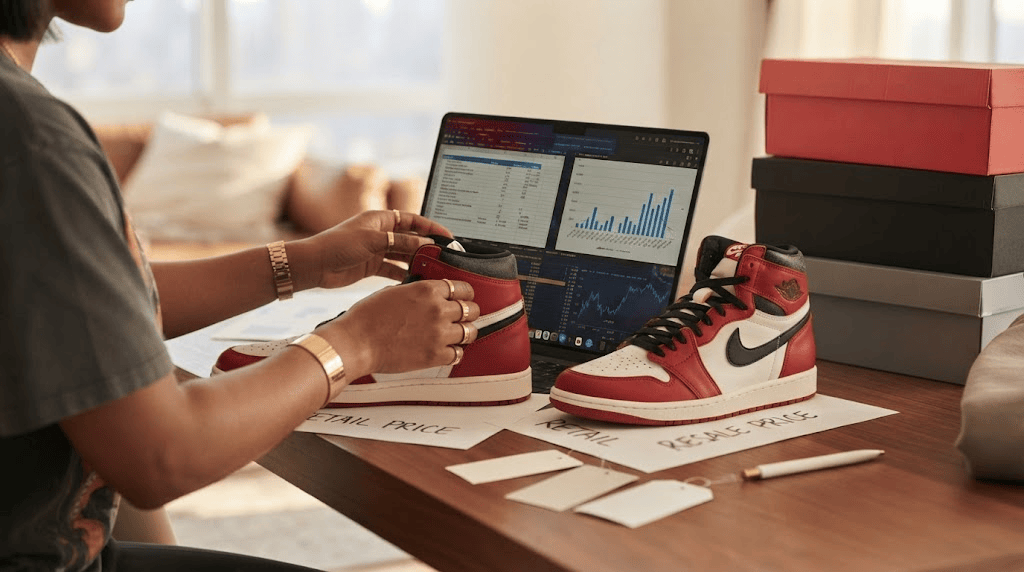
Retail Price vs. Resale Price
Consider a hypothetical sneaker:
| Factor | Example |
|---|---|
| Original retail price | $180 |
| Available supply | Limited |
| Current buyer demand | Very high |
| Resale transaction | $425 |
| Gross premium | $245 |
| Gross percentage premium | 136% |
That 136% premium is not automatically profit.
A seller still needs to consider platform fees, shipping, taxes, acquisition cost, and potential return or authentication issues.
This distinction is often missing from simplified resale discussions: a high resale price does not necessarily mean a high net profit.
Why Do Some Streetwear Items Lose Value?
Not every limited item becomes a valuable collectible.
This is one of the most important lessons for anyone studying the resale market.
Too Much Supply Can Kill the Premium
If a brand repeatedly releases large quantities of similar products, scarcity becomes weaker.
The market can also become saturated when too many sellers attempt to sell the same item simultaneously.
More listings mean buyers have more choices.
Hype Can Disappear
A product can trend heavily on TikTok, Instagram, or X and still lose demand once the conversation moves elsewhere.
Streetwear is particularly sensitive to cultural cycles.
What is considered essential today may look dated next year.
Brand Relevance Can Change
A strong resale history does not guarantee future performance.
StockX’s data demonstrates this clearly. In 2024, traditional leaders such as Nike and Jordan experienced slower resale activity in some areas, while challenger brands such as ASICS gained significant momentum. StockX reported ASICS growth of 589% year over year in its analyzed period.
The lesson is simple:
Past resale performance is evidence, not a guarantee.
Condition Matters
Two identical products can have very different resale prices.
Important variables include:
- New vs. used condition
- Original packaging
- Tags
- Receipts or proof of purchase
- Wear
- Stains or damage
- Sole condition for sneakers
- Correct accessories
- Authenticity
The growth of used resale also shows how the market is expanding beyond brand-new products. In 2026, StockX introduced Listings for used sneakers, vintage fashion, and other items, creating additional price points for buyers and sellers.
What Streetwear Products Usually Have Strong Resale Potential?
There is no guaranteed formula, but certain characteristics repeatedly appear in high-demand products.
Limited-Edition Sneakers
Sneakers remain one of the most visible parts of the resale economy because they combine collectibility, sizing, scarcity, and established authentication infrastructure.
StockX reported that certain 2024 collaborations achieved very large average price premiums, including examples from Nike and Jordan collaborations.
Iconic Hoodies and Graphic Apparel
Streetwear hoodies, logo pieces, and distinctive graphic releases can maintain demand when they become strongly associated with a brand’s identity.
Artist and Celebrity Collaborations
Products connected to influential cultural figures can experience sudden demand increases.
However, celebrity association alone is not enough. The collaboration needs to feel authentic to the culture surrounding the brand.
Archive and Vintage Pieces
Older products can become more desirable when a brand’s aesthetic returns to popularity.
This creates an interesting cycle:
old trend → renewed interest → archive demand → scarcity → higher resale value
Does Resale Data Really Predict What Will Become Popular?
Resale data can reveal useful signals, but it should not be treated as a crystal ball.
Platforms with large marketplaces can show:
- Transaction volume
- Average prices
- Price premiums
- Search activity
- Buyer offers
- Seller asks
- Product availability
- Brand growth
StockX’s 2026 reporting, for example, showed that Supreme apparel sales rose 19% year over year in the first half of 2026, while its average price premium increased from 11% to 41%.
That is more useful than simply saying “Supreme is popular.”
It gives us a measurable indication that demand and pricing behavior changed.
An Original Example: Why Size Can Change the Market
Consider two buyers looking for the same limited sneaker.
Buyer A needs a common men’s size with hundreds of listings.
Buyer B needs an uncommon size with only a handful of listings.
Even if the sneakers are identical, Buyer B may face a much higher price because availability is being measured at the size level, not just the product level.
This is an important practical insight when evaluating resale prices: the market is not one single price. It is a collection of micro-markets organized around size, condition, geography, and timing.
Which Platforms Drive the Streetwear Resale Market?
The modern market includes specialized marketplaces, community-driven platforms, sneaker platforms, and general resale services.
Examples include StockX, GOAT, Grailed, eBay, and other fashion resale marketplaces.
Each platform can produce different pricing because its audience, fees, authentication processes, seller tools, and product mix differ.
StockX describes its marketplace as a real-time pricing environment where buyers can place offers and sellers can set asks.
That structure makes resale pricing more visible than the traditional secondhand market.
Comscore also found that visits to major resale sites collectively increased 3% over a two-year period, while apparel-site visits declined 30% during the comparison period it analyzed in May 2024.
How Authenticity Affects Streetwear Resale Prices
Authenticity is one of the biggest differences between legitimate resale and an unverified peer-to-peer transaction.
A counterfeit item may look similar to the original but has little legitimate market value.
That is why authentication can become part of the product’s economic value.
When a platform verifies an item, it reduces uncertainty for the buyer. Lower uncertainty can make buyers more comfortable paying market prices.
The FTC advises online shoppers to examine product descriptions carefully and warns that unusually cheap expensive brand-name products can be counterfeit or stolen.
For expensive streetwear, buyers should check:
- Seller reputation
- Authentication policy
- Product photographs
- Condition description
- Original packaging
- Return policy
- Purchase documentation when available
- Platform protection
Is Streetwear Resale an Investment?
It can behave like an investment, but calling every streetwear purchase an investment is misleading.
Unlike stocks or bonds, streetwear does not generate cash flow simply because you own it.
Its value depends on another buyer being willing to pay more.
That means resale markets can be highly sensitive to:
- Trends
- Economic conditions
- Consumer spending
- Brand reputation
- New releases
- Cultural changes
- Supply
- Platform fees
A better description is collectible consumer goods with market-based resale value.
Some pieces appreciate significantly. Others decline below retail.
The safest mindset for a consumer is to buy something because they genuinely like it first and treat potential resale upside as secondary.
Is Streetwear Resale Sustainable?
Resale can extend the useful life of clothing and footwear by keeping products in circulation instead of sending them directly into disposal streams.
Comscore identified environmental concerns around fast fashion as one factor contributing to the popularity of resale platforms.
But resale is not automatically sustainable.
If consumers buy products purely to flip them quickly, resale can also encourage additional purchasing and speculation.
The sustainability benefit is strongest when resale replaces the need to manufacture and purchase another new item.
What Does the Future of the Streetwear Resale Market Look Like?
The resale market is becoming more sophisticated.
Three developments are particularly important.
1. More Used Inventory
The market is expanding beyond deadstock.
StockX’s 2026 Listings launch illustrates the direction: buyers can increasingly compare used and new products, while sellers can monetize items they have already worn.
2. Better Market Data
Pricing is becoming increasingly transparent.
Historical transactions, offers, sales volume, and price premiums give consumers more information before they buy.
3. Faster Trend Cycles
Social media can create demand much faster than traditional fashion media.
That means resale prices can move quickly in both directions.
A product can become hot because of a viral moment—and cool just as quickly when attention shifts.
The Bottom Line: Why Do Streetwear Prices Skyrocket?
The resale market becomes expensive when scarcity meets strong demand.
But the strongest resale products usually have several forces working together:
- Limited supply
- Strong brand identity
- Cultural relevance
- Collaborations
- Social media visibility
- Collector interest
- Authenticity
- Timing
- Condition
- Available sizes
- A motivated buyer base
The biggest misconception is that hype alone creates value.
It does not.
Hype creates attention. Scarcity restricts supply. Culture creates meaning. Demand creates the price.
That combination explains why an ordinary-looking streetwear item can become dramatically more expensive after its original retail release.
For anyone studying fashion, buying streetwear, or simply wondering why resale prices seem so extreme, understanding these forces is more useful than memorizing which brands are currently “hot.”
FAQ Section
What is the streetwear resale market?
The streetwear resale market is the secondary market where consumers buy and sell previously released streetwear products after their original retail release. Prices are determined largely by supply, demand, scarcity, condition, and cultural relevance.
Why are streetwear resale prices so high?
Streetwear resale prices can become high when demand exceeds available supply. Limited releases, collaborations, celebrity influence, cultural relevance, and social media hype can all increase demand.
Does limited-edition streetwear always increase in value?
No. Limited supply alone does not guarantee appreciation. A product can lose value if consumer interest falls, too many similar products enter the market, or the brand loses cultural relevance.
Which streetwear items usually have the strongest resale value?
Limited sneakers, sought-after collaborations, iconic hoodies, rare graphics, archive pieces, and products connected to influential brands or cultural moments can have strong resale demand.
Is buying streetwear for resale a good investment?
Streetwear can appreciate, but resale is speculative. Prices can fall because of changing trends, increased supply, economic conditions, or declining brand relevance. Buyers should not assume future profit.
How can buyers avoid fake streetwear?
Use reputable marketplaces with authentication or strong buyer protections, research seller history, inspect product details, compare pricing, and be cautious when an expensive branded item is offered at an unusually low price.
Pingback: 5 Underrated Streetwear Brands to Watch in 2026
Pingback: Best Streetwear Drops to Expect This Fall/Winter 2026