Brands
Yayoi Kusama: How Infinity Art Shaped Modern Streetwear Culture

Origins: Yayoi Kusama’s Early Life and Beginnings
Yayoi Kusama was born on March 22, 1929, in Matsumoto, Nagano, Japan, to a family that owned a plant nursery and seed farm. When she was ten years old, she experienced vivid hallucinations involving repetitive patterns and dots, and she began sketching what she saw. These experiences became the foundation of her artistic vision and lifelong obsession with repetitive motifs.
As a child, Kusama began drawing scenes filled with dots and patterns that reflected her perceptions. Her mother discouraged her artistic interests and even destroyed some early works, creating emotional challenges that would shape Kusama’s psychological and creative worldview.
In 1948–1949, she attended the Kyoto City Specialist School of Arts but left formal education early. By 1957, her desire to pursue a career as an artist and escape family conflict led her to move to the United States, a decision that marked the beginning of her international art career.
Emerging Artist: Nets and New York Avant‑Garde
In New York during the late 1950s and 1960s, Kusama became known for her “infinity net” paintings—vast canvases covered in networks of tiny, repetitive marks that extended visually beyond the edges of the surface. These works explored the psychological boundaries of perception and infinity.
Her work quickly evolved, and she became part of the avant‑garde art scene, exhibiting alongside artists such as Donald Judd, Claes Oldenburg, and Andy Warhol. She embraced Pop art, Minimalism, and performance art, often staging radical happenings that challenged social norms, gender roles, and artistic boundaries.
In the early 1960s, Kusama’s art included sculpture and installation, notable among them Accumulation No. 1 (1962)—an armchair covered with soft phallic forms—and Infinity Mirror Room—Phalli’s Field (1965), a mirrored installation filled with dotted objects that created endless reflections.
Artistic Philosophy: Obsession, Repetition, and Infinity
Kusama’s art centers on themes of repetition, self‑obliteration, and infinity—ideas rooted in the hallucinations she experienced as a child. She used repeated dots, nets, and mirrored surfaces to depict endless space and psychological immersion, linking personal experience with universal concepts of eternity and existence.
Kusama herself described her artistic drive as an “obsessive artist,” creating work that dissolves boundaries between self and environment. Her dots and nets became symbolic; they obliterate form while creating visual fields that suggest infinity and interconnectedness.
Her early performances in New York included antiwar and anti-establishment happenings, sometimes involving naked participants covered in dots. These events questioned identity, conformity, and artistic boundaries, situating Kusama as a provocative figure in the art world during a time of cultural upheaval.
Return to Japan and Continued Creativity
In 1973, Kusama returned to Japan and, from 1977 onward, chose to live in a psychiatric hospital near her studio in Tokyo while continuing to produce art daily. Her decision reflected a desire for stability and focus on creation rather than confinement.
During this period, she wrote surreal fiction and poetry while maintaining a rigorous art practice. Kusama’s writing, including novels such as The Hustlers Grotto of Christopher Street (1978) and Between Heaven and Earth (1988), mirrored the intense psychological themes of her visual art.
By the late 1980s and early 1990s, Kusama returned to global art stages with major exhibitions in New York and Europe. In 1993, she represented Japan at the Venice Biennale, showcasing works such as Mirror Room (Pumpkin)—an installation combining her signature dots with mirrored environments.
Global Recognition and Immersive Installations
From the late 1990s onward, Kusama’s international stature grew, with major retrospectives at institutions such as the Los Angeles County Museum of Art and the Museum of Modern Art (MoMA) in New York. These exhibitions celebrated her influence across decades and mediums.
Her Infinity Mirror Rooms—immersive installations lined with mirrors, lights, and repeated objects—became iconic in contemporary art. Works like Infinity Mirrored Room – Filled with the Brilliance of Life (2011) evolved from her early obsessions with repetition to fully immersive cosmic environments. Kusama also explored fashion and collaborations beyond the gallery. In 1968, she launched Kusama Fashion Company Ltd., creating polka-dotted garments sold in Bloomingdale’s, demonstrating her early fusion of art and design. In 1969, she opened her own boutique, and later collaborations included limited editions with Louis Vuitton, bringing her visual language into the world of fashion.
Major Works: Infinity Mirror Rooms, Narcissus Garden, and Pumpkin Sculptures

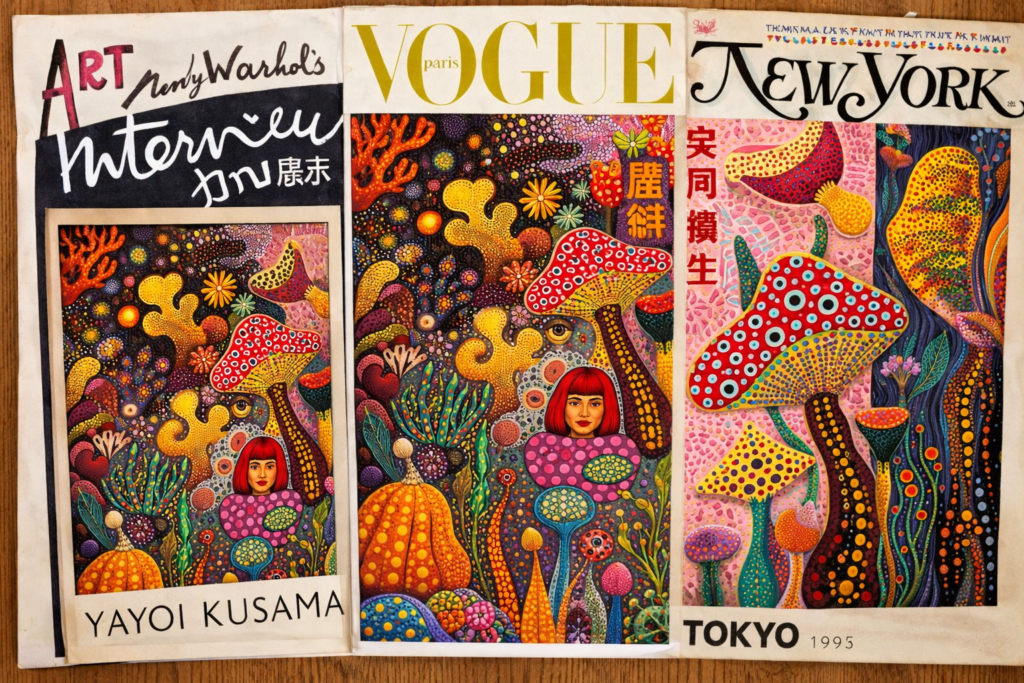
Yayoi Kusama’s Infinity Mirror Rooms are perhaps her most recognizable contributions to contemporary art. First conceived in the 1960s, these installations use mirrors, lights, and repetitive objects to create the illusion of infinite space. The visitor becomes part of the artwork, experiencing immersion and disorientation simultaneously. Works like Infinity Mirror Room – Phalli’s Field (1965) and The Souls of Millions of Light Years Away (2013) transform perception, blurring the boundaries between self and environment. (yayoikusamamuseum.jp)
Another hallmark of Kusama’s oeuvre is the Pumpkin series, inspired by her childhood memories of pumpkins at her family farm. These sculptures, often painted in vivid polka dots, became iconic symbols of her work. Installations like the giant outdoor pumpkin at Naoshima Island, Japan, merge natural form with her signature patterns, connecting folk imagery to avant-garde abstraction. Narcissus Garden (1966) challenged conventional art contexts and commercialism. Originally installed at the Venice Biennale, it consisted of hundreds of mirrored spheres floated on the water and placed on the lawn, reflecting both the environment and viewers. Kusama sold the spheres for two dollars each outside the pavilion, subverting the traditional artist-gallery relationship and questioning the commodification of art.
Yayoi Kusama Brand Evolution Timeline
| Year | Milestone / Event |
| 1929 | Born in Matsumoto, Japan. Early obsession with repetition, polka dots, and infinity becomes the foundation of a visual language later adopted by streetwear culture. |
| 1957 | Moves to New York, immersing herself in avant-garde and counterculture scenes—paralleling early streetwear’s rebellion and anti-establishment mindset. |
| 1965 | Creates the first Infinity Mirror Room, introducing immersive environments that later inspire experiential retail spaces and fashion installations. |
| 1966 | “Narcissus Garden” critiques consumerism—an idea deeply connected to modern streetwear drops, hype culture, and resale markets. |
| 1967 | Kusama’s “Happenings” (performance art) blur art, fashion, and protest—early examples of wearable art influencing future streetwear expression. |
| 1973 | Returns to Japan, continuing to create art rooted in identity and mental health—themes widely explored in contemporary streetwear storytelling. |
| 1993 | Represents Japan at the Venice Biennale, marking her global resurgence and influencing a new generation of artists and designers. |
| 2000 | Infinity aesthetics (dots, repetition, immersive visuals) begin influencing fashion graphics, prints, and conceptual streetwear design. |
| 2012 | Major collaboration with Louis Vuitton introduces Kusama’s polka dots to global fashion, bridging luxury and streetwear culture. |
| 2017 | Kusama Museum opens in Tokyo, becoming a cultural hotspot and visual inspiration for creatives, designers, and streetwear brands. |
| 2018 | Exhibitions at institutions like Tate Modern amplify her influence across visual culture, fashion editorials, and streetwear campaigns. |
| 2020 | Digital exhibitions inspire virtual fashion and online drops, aligning with streetwear’s shift toward digital culture and global accessibility. |
| 2021 | Infinity Mirror Rooms drive “Instagram culture,” influencing streetwear marketing, visuals, and hype-driven brand storytelling. |
| 2022 | Second collaboration with Louis Vuitton merges art, luxury, and streetwear aesthetics—seen in hoodies, sneakers, and accessories. |
| 2023 | Kusama’s patterns dominate fashion capsules, inspiring streetwear brands to adopt bold repetition, color blocking, and immersive branding. |
| 2024 | Continued influence on experimental streetwear—AI visuals, immersive pop-ups, and conceptual retail spaces echo Kusama’s infinity philosophy. |
| 2025 | Kusama’s legacy defines the intersection of art and streetwear—her polka dots, infinity concepts, and immersive vision continue shaping fashion, hype culture, and creative direction globally. |
Yayoi Kusama Streetwear Influence
Yayoi Kusama’s impact on streetwear comes from her lifelong mission to merge art with everyday life, a vision she began exploring as early as the 1960s when she launched experimental fashion pieces in New York to challenge social norms and consumer culture. Decades later, this philosophy naturally translated into modern streetwear through collaborations with brands like Louis Vuitton and X-Girl.
In 2012, creative director Marc Jacobs invited Kusama to reinterpret iconic products using her signature polka dots and infinity patterns, followed by a larger 2023 collection that included sneakers, ready-to-wear shirts, and accessories designed as wearable art. These sneakers often featured bold color blocking and repetitive dot motifs, transforming functional footwear into collectible design objects, while graphic shirts showcased her immersive artwork imagery, bridging gallery culture with street fashion.
Collectibles such as limited-edition bags, accessories, and special packaging became highly sought after because they carried both artistic value and brand prestige. Kusama’s streetwear relevance exists because her themes of repetition, identity, and self-expression align perfectly with youth culture and hype-driven fashion. By turning clothing into art experiences, she influenced how collaborations function today, where scarcity, visual impact, and storytelling create cultural demand beyond traditional fashion.
Yayoi Kusama Limited Drops, Graphic Shirts, Sneakers, and Collector Culture
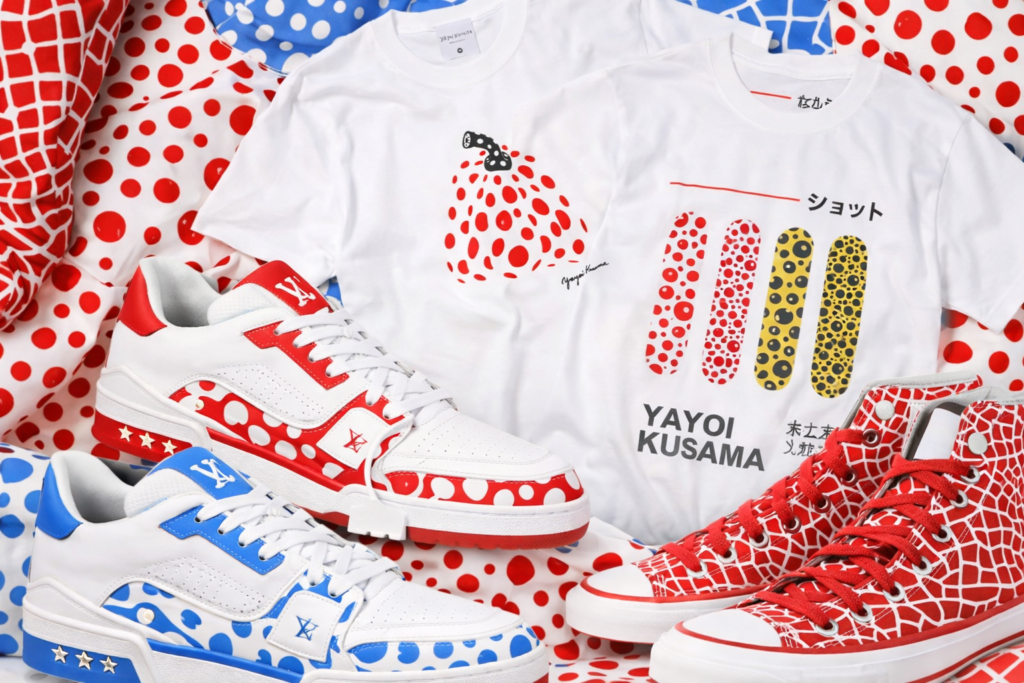
A key reason Yayoi Kusama resonates with streetwear audiences is the way her art adapts to modern drop culture and collectible fashion ecosystems. Rather than simply printing artwork onto garments, brands have used her motifs to create immersive product stories that extend across shirts, sneakers, and accessories released in timed launches. Collaborations with companies like Uniqlo introduced affordable graphic T-shirts that allowed younger consumers to access museum-level art through everyday clothing, while premium releases from luxury houses targeted collectors seeking rarity and status.
Sneakers inspired by her work often incorporate high contrast color palettes, layered textures, and sculptural details that mirror her installations, turning footwear into statement pieces rather than basic merchandise. Shirts function as portable canvases that emphasize individuality, which aligns with streetwear’s core values of identity and self expression.
Collectibles such as bags, small leather goods, and special packaging gain secondary market demand because they sit at the intersection of art ownership and fashion hype. Brands pursue Kusama collaborations not only for aesthetics but because her global recognition bridges generations, cultures, and price tiers, allowing streetwear to connect art institutions, luxury consumers, and youth communities within a single cultural moment.
Cultural Influence, Exhibitions, and Legacy
Kusama’s influence spans multiple disciplines—visual art, literature, fashion, and popular culture. Her avant-garde performances in the 1960s influenced feminist and conceptual art movements, inspiring artists like Marina Abramović and Carolee Schneemann. Her obsessive repetition and immersive environments anticipated aspects of installation art and experiential exhibitions that dominate contemporary museum practice.
Her work has been featured in retrospectives at institutions such as the Tate Modern (London), Whitney Museum of American Art (New York), and Pompidou Centre (Paris). These exhibitions not only celebrate her longevity but also showcase her evolving use of materials and psychological depth, establishing her as a bridge between mid-20th-century avant-garde and 21st-century immersive art.
Kusama’s writings, including her poetry and novels, also contribute to her cultural legacy. Her autobiographical accounts, such as Infinity Net (2002), provide insight into her mental health struggles, her hallucinations, and the role of obsession in her creative process. By merging life experience and art, Kusama has influenced generations of artists and writers worldwide.
Awards, Honors, and Institutional Impact
Yayoi Kusama has received global recognition for her contributions to art. In 2006, she was awarded the Premium Imperiale by the Japan Art Association, often considered the Nobel Prize of the arts. She has also received the Order of Culture from the Japanese government and honorary doctorates from prestigious institutions.
Museums worldwide have acquired Kusama’s works, creating dedicated spaces for her installations. The Yayoi Kusama Museum in Tokyo, opened in 2017, provides structured access to her work through rotating exhibitions, highlighting her global influence. Her practice continues to inspire museum curatorial approaches, particularly in designing immersive, visitor centered exhibitions.
Her achievements are notable not only for artistic innovation but also for mental health advocacy, as she has openly discussed her psychiatric treatment and how art functions as therapy. This has created a unique intersection between art, wellness, and public discourse, emphasizing the societal impact of her work.
Modern Popularity and Social Media Phenomenon
In recent years, Kusama’s popularity has surged among younger audiences through social media platforms, particularly Instagram. Her visually striking installations, especially the mirrored Infinity Rooms, are frequently shared online, transforming her work into global photo and cultural experiences. The immersive nature of her exhibitions encourages engagement and participation, contributing to her status as a pop-culture icon.
Her collaborations with fashion brands such as Louis Vuitton and participation in large scale public art projects, including enormous outdoor pumpkin sculptures, bridge the gap between fine art and commercial culture. These partnerships further cement Kusama’s influence across contemporary design, fashion, and lifestyle markets, expanding her reach beyond traditional gallery spaces.
Kusama continued to produce work well into her 90s, maintaining a global presence through exhibitions, collaborations, and publications. Her art remains a vivid exploration of psychedelic perception, obsessive repetition, and human connection, ensuring that her legacy will influence generations to come.
Conclusion
Yayoi Kusama’s work transcends traditional art boundaries, merging painting, sculpture, and immersive installations into a global phenomenon. Her signature polka dots, infinity rooms, and surreal motifs have influenced not only contemporary art but also streetwear and fashion collaborations, inspiring designers and brands worldwide. Kusama’s fearless exploration of mental health, repetition, and obsession resonates across generations, making her a cultural icon. Her impact is seen in galleries, museums, and urban spaces, blending creativity with accessibility. From high fashion to streetwear collaborations, Kusama proves that art is limitless, immersive, and transformative, leaving an enduring mark on culture and style.
Frequently Asked Questions (FAQs)
1. Who is Yayoi Kusama?
Yayoi Kusama is a Japanese contemporary artist known for her polka dot patterns, infinity rooms, sculptures, and immersive installations.
2. What are Infinity Mirror Rooms?
Infinity Mirror Rooms are immersive installations by Kusama using mirrors and lights to create the illusion of endless space.
3. How has Kusama influenced streetwear?
Her bold patterns and polka dots have inspired fashion designers and streetwear brands, appearing on clothing, sneakers, and accessories worldwide.
4. Where can I see Yayoi Kusama’s work?
Her work is displayed in major museums globally, including the Yayoi Kusama Museum (Tokyo), Tate Modern (London), and Guggenheim (New York).
5. What is Kusama’s signature motif?
Polka dots, nets, and pumpkins are her iconic motifs, representing infinity, obsession, and mental landscapes.
6. Has Kusama collaborated with fashion brands?
Yes, she has collaborated with Louis Vuitton, Supreme, and other streetwear and luxury brands, merging art with fashion.
7. What inspired Kusama’s art style?
Her experiences with hallucinations, mental health, and obsession with repetition shaped her unique visual language.
8. When did Kusama start her art career?
She began formally studying art in the 1940s and gained international recognition in the 1960s after moving to New York.
9. Are Kusama’s works collectible?
Yes, her paintings, sculptures, and limited-edition fashion collaborations are highly collectible and valued globally.
10. What is “Narcissus Garden”?
A 1966 installation of mirrored spheres that challenged commercialization and interaction in art, first shown at the Venice Biennale.
11. How does Kusama address mental health in her art?
Through repetition, immersive spaces, and personal narratives, Kusama channels her experiences into visually therapeutic and expressive works.
12. Are there Kusama exhibitions for children?
Yes, her colorful and interactive installations are often family friendly and engaging for young audiences.
13. Does Kusama still create art today?
Yes, she continues to produce paintings, sculptures, and installations daily at her Tokyo studio.
14. How do I visit the Yayoi Kusama Museum?
Located in Tokyo, advance tickets are recommended due to timed entries and high demand.
15. Can Kusama’s art inspire DIY streetwear?
Absolutely! Her polka dot patterns and bold designs are popular inspirations for custom streetwear, clothing, and accessories.
For collaborations, press, or inquiries, contact us at streeticonic1@gmail.com.