Brands
Why Is Stussy Still One of the Most Influential Streetwear Brands in 2026?

Why Is Stüssy Still One of the Most Influential Streetwear Brands in 2026? The answer is surprisingly simple: Stüssy has never depended entirely on hype. Its influence comes from a combination of surf culture, skateboarding, hip hop, graphic design, music, international communities, selective retail, and a willingness to evolve without abandoning its identity.
Stüssy began in Southern California in the early 1980s when Shawn Stussy put his distinctive signature on surfboards and then carried that visual language onto clothing. What started as a local surf project eventually became a global streetwear reference point.
In 2026, the brand is still releasing seasonal collections, operating Chapter Stores across major cities, and collaborating with influential names in fashion and outdoor culture. Its Summer ’26 collection, for example, launched worldwide through selected Chapter Stores and Stussy.com in May 2026.
That combination of history and current relevance explains why Stüssy continues to sit among the most influential streetwear brands.


Why Is Stussy Still So Influential in 2026?
Stüssy’s influence is not based on being the newest brand in streetwear. It is almost the opposite.
The brand has survived several changes in fashion because its core identity is flexible enough to absorb new cultural movements. Surfing, skateboarding, hip hop, punk, art, Japanese fashion, luxury design, and contemporary street culture have all interacted with Stüssy over the decades.
The important distinction is that Stüssy rarely looks like it is desperately chasing each new movement.
That restraint matters.
A useful way to understand the brand is to separate trend popularity from cultural influence. A brand can become popular because of one viral product. Influence is harder to maintain. It means other designers, brands, artists, retailers, and consumers continue to borrow from or respond to the ideas associated with the original label.
Stüssy has achieved that kind of influence for decades.
Stüssy’s Origins Gave It an Authentic Streetwear Foundation
From surfboards to T-shirts
Shawn Stussy was already connected to Southern California surf culture before clothing became the main business.
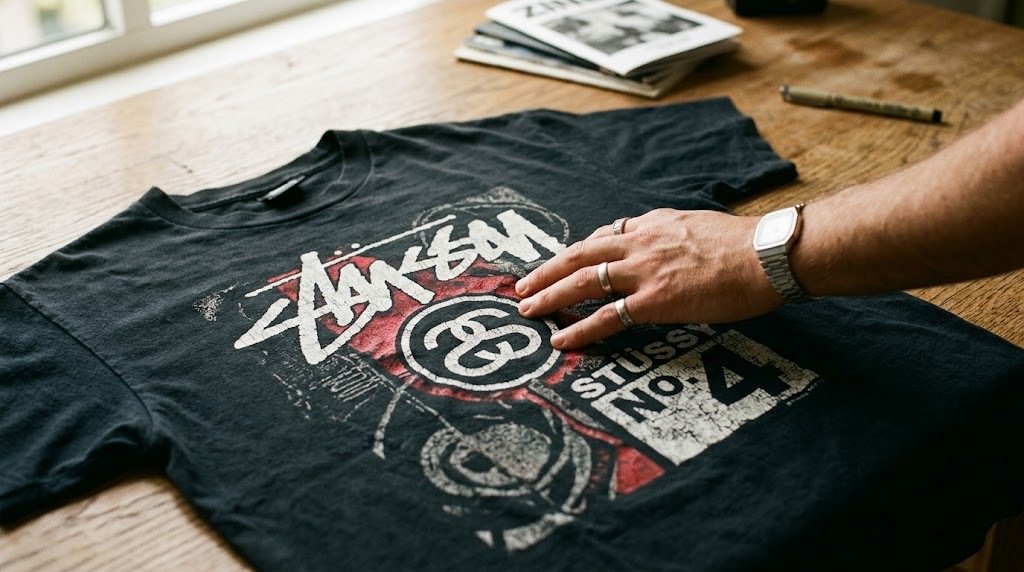
He shaped surfboards in Laguna Beach and used his surname as a distinctive mark on his boards. That signature eventually appeared on T-shirts and other clothing. Highsnobiety’s timeline records a particularly important early moment: in 1982, Stussy used the logo on black T-shirts at the Action Sports Retailer trade show, where the shirts reportedly sold extremely well alongside the boards.
This origin story explains something important about the brand’s visual identity.
The logo did not begin as a corporate branding exercise designed by a large marketing department. It grew from a personal signature connected to a real creative practice.
That made the identity easy to recognize but difficult to imitate convincingly.
Stüssy connected different subcultures
Stüssy soon moved beyond surf culture.
Its clothing found audiences among skateboarders, musicians, hip hop communities, artists, and young consumers who were interested in the emerging idea of casual clothing as cultural expression. Wikipedia similarly describes the brand’s evolution from surfwear into skateboarding and hip hop culture.
This crossover became one of Stüssy’s biggest competitive advantages.
Instead of belonging exclusively to one scene, it could participate in several scenes at once.
That is a major reason its aesthetic still works in 2026.
How Did Stüssy Become a Global Streetwear Brand?
Stüssy’s global influence was built through people and communities rather than simply through mass advertising.
By the late 1980s, the brand had reached Europe and was gaining recognition among hip hop communities. It also developed stockists across the United States, Europe, Australia, and Japan.
One of the most important developments was the International Stüssy Tribe.
The idea was larger than simply selling clothing. It connected influential people from different creative communities around a shared attitude toward style.
The result was a network that helped Stüssy feel international without becoming culturally generic.
The World Tour graphic became a blueprint
The Stüssy World Tour T-shirt is one of the clearest examples of this approach.
The original World Tour concept appeared in 1989 and placed cities such as London, Paris, Los Angeles, New York, and Tokyo together on a graphic. Stüssy itself describes the design as a meeting point between different cultural worlds.
That idea remains relevant because streetwear is increasingly global.
A consumer in Los Angeles can recognize the same visual language as someone in Tokyo, Seoul, London, or New York.
The World Tour concept effectively turned geography into part of the brand identity.
Why Are Stüssy Chapter Stores So Important?
One of the biggest gaps in many general Stüssy explainers is the importance of Chapter Stores.
Stüssy does not treat every retail location as simply another place to sell the same products.
Its current Chapter directory includes locations such as Los Angeles, New York, London, Seoul, Amsterdam, Bangkok, Beijing, Shanghai, Tokyo, Singapore, Sydney, Taipei, Toronto, and Vancouver, among others.
This physical network reinforces the idea that Stüssy is a global community made up of local scenes.
Chapter products create local identity
Chapter products can also feel more meaningful because they connect the clothing to a specific city.
A person visiting Tokyo, Honolulu, London, or another Stüssy location may want something that represents that particular place.
This helps explain why consumers sometimes treat Chapter pieces more like cultural souvenirs or collectibles than ordinary graphic T-shirts.
A Reddit discussion about Stüssy illustrates this consumer perspective particularly well. Several users described the appeal of Chapter products as being connected to rarity, location, and the feeling of having been somewhere.
That community discussion is useful because it reveals something traditional brand histories often miss: people do not always buy Stüssy simply because they like the logo. They buy into the story attached to where and how they encountered it.
Stüssy’s Design Philosophy Has Changed Without Losing Its Identity
Another reason Stüssy remains among the influential streetwear brands is its ability to update the product without completely rewriting the brand.
The classic Stüssy graphic T-shirt remains important, but the company has expanded into outerwear, trousers, knitwear, accessories, tailored pieces, technical clothing, and other categories.
This matters because a mature streetwear label faces a difficult problem.
If it changes too much, longtime customers may say it has lost its identity.
If it changes too little, younger customers may consider it irrelevant.
Stüssy has generally operated between those extremes.
The 2010s turnaround changed the brand’s position
GQ’s 2021 examination of Stüssy’s revival provides an especially important piece of the story.
According to GQ, the company began moving away from some larger retail relationships and became more selective about where it sold. Under David Sinatra and leadership including Fraser Avey, the brand focused on improving design and presentation rather than simply maximizing distribution.
That strategy was significant.
Instead of asking, “How many stores can carry Stüssy?” the brand increasingly asked, “Which environments make Stüssy feel culturally appropriate?”
Its relationship with Dover Street Market was particularly important because it placed Stüssy in a retail environment associated with experimental and high-end fashion.
This helped reposition Stüssy from an old surf and skate label into a serious contemporary fashion brand without requiring it to abandon its roots.
Why Do Stüssy Collaborations Matter So Much?
Stüssy collaborations work because they usually create a conversation between different cultures rather than simply placing two logos next to each other.
The brand has collaborated with names across fashion, footwear, art, music, and outdoor culture.
Its 40th anniversary World Tour project is a strong example. In 2020, Stüssy invited designers including Rick Owens, Virgil Abloh, Takahiro Miyashita, Marc Jacobs, and Martine Rose to reinterpret the World Tour concept.
That is strategically different from a basic celebrity endorsement.
Each collaborator brought an established creative language into Stüssy’s world.
Modern collaborations keep the brand culturally active
The same approach continues in 2026.
Recent Stüssy projects include collaborations with Our Legacy, while earlier 2025 projects included collaborations with Nike and Wales Bonner. The Wales Bonner project, for example, connected Stüssy’s surf heritage with references spanning Los Angeles, Accra, Tokyo, and Santa Ana.
The Nike collaboration also demonstrates how Stüssy can move into technical and outdoor territory while maintaining its streetwear identity.
This is one of the clearest answers to the question of why Stüssy still matters.
The brand does not need every collaboration to look exactly like classic Stüssy. It needs each collaboration to make sense within the larger Stüssy worldview.

What Makes Stüssy Different From Newer Streetwear Brands?
New streetwear brands can generate enormous attention in a short period.
Stüssy has something that cannot be manufactured quickly: historical credibility.
The brand has existed since the early 1980s, which means it has witnessed several generations of streetwear development.
That gives Stüssy a different relationship with trends.
A younger label may need to explain why its aesthetic matters.
Stüssy can reference its own archive.
A graphic, silhouette, city reference, or collaboration can carry meaning because consumers already understand where the visual language comes from.
Stüssy does not need to be everywhere
This is another important distinction.
GQ reported that Stüssy’s leadership prioritized being good rather than pursuing unlimited growth. The company deliberately accepted the financial consequences of reducing some distribution and improving product and retail quality.
That philosophy has helped protect the brand from overexposure.
Scarcity alone does not create cultural relevance.
But selective availability plus a strong identity can make products feel more intentional.
That distinction helps explain why Stüssy can remain desirable without behaving exactly like a conventional luxury label.
Is Stüssy Still Popular in 2026?
Yes, although its popularity looks different depending on the market.
Stüssy’s current Chapter network demonstrates an active international retail presence, while its 2026 collections continue to launch across North America, Europe, the UK, Japan, Korea, and other markets.
The brand’s relevance is especially visible when you look beyond a single country.
A consumer in the United States might encounter Stüssy as a heritage California streetwear brand.
A consumer in Japan may encounter it as an established part of international fashion culture.
Someone discovering the brand through a collaboration may know it primarily through contemporary designers or footwear.
All three perspectives can be correct.
That adaptability is part of the reason Stüssy remains one of the influential streetwear brands in 2026.
What Can Other Streetwear Brands Learn From Stüssy?
Stüssy’s longevity offers several lessons for both established and emerging labels.
1. Build an identity before building hype
The signature came from Shawn Stussy’s own creative practice. That gave the brand a recognizable starting point.
2. Create a community, not just an audience
The International Stüssy Tribe helped turn customers and creatives into participants in a wider cultural network.
3. Protect distribution
Being available everywhere is not automatically beneficial. Stüssy’s selective retail strategy helped strengthen its positioning.
4. Collaborate across cultures
The strongest collaborations introduce new perspectives rather than simply adding another famous logo.
5. Respect the archive without becoming trapped by it
Stüssy can reference its past while continuing to produce new silhouettes, collaborations, and seasonal collections.
6. Let local scenes matter
The Chapter Store model demonstrates how a global brand can maintain a connection to individual cities.
The Biggest Reason Stüssy Still Matters in 2026
The strongest answer is not the logo, the price, the collaborations, or nostalgia.
It is continuity.
Stüssy has maintained a recognizable cultural point of view while allowing different generations to interpret it differently.
Someone who discovered the brand through 1990s skate culture can see one thing.
Someone discovering Stüssy through a 2026 collaboration can see something else.
Yet both can recognize the same brand.
That is difficult to achieve.
My own takeaway after examining Stüssy’s development across multiple eras is that its biggest advantage is not simply longevity. It is the brand’s ability to make its history feel usable rather than untouchable. The World Tour graphic is a good example: first introduced in 1989, it has repeatedly been reinterpreted, including the 40th anniversary project and later collaborations.
That gives Stüssy something many newer brands cannot buy: a living archive.
Final Verdict: Why Is Stussy Still One of the Most Influential Streetwear Brands in 2026?
Stüssy remains influential because it combines authenticity, design consistency, cultural connections, selective retail, global reach, and decades of accumulated credibility.
It began with surfboards in Southern California but expanded into skateboarding, hip hop, art, music, fashion, and international street culture.
Its current collections and collaborations show that the brand is not surviving on nostalgia alone. It is still creating new products, working with contemporary creative partners, and operating a global Chapter Store network in 2026.
That is the real difference between a heritage streetwear brand and a genuinely influential one.
Stüssy did not simply survive streetwear’s changing trends.
It helped establish the language that many of those trends still speak.
FAQ Section
Why is Stüssy still popular in 2026?
Stüssy remains popular because it combines decades of streetwear heritage with current collections, selective retail, global Chapter Stores, and collaborations with contemporary fashion and cultural brands.
What makes Stüssy an influential streetwear brand?
Stüssy’s influence comes from its early connection to surf, skate, hip hop, art, and music culture, plus its distinctive graphics, International Stüssy Tribe, global retail network, and long history of collaborations.
Is Stüssy considered a luxury streetwear brand?
Stüssy is better described as a premium or influential streetwear brand rather than a traditional luxury fashion house. Its selective distribution and collaborations have helped it occupy a space between mainstream streetwear and contemporary fashion.
4. Why are Stüssy Chapter T-shirts popular?
Chapter T-shirts connect Stüssy with individual cities and can offer a stronger sense of place and scarcity than standard releases. This makes them attractive to collectors, travelers, and longtime fans.
Where did Stüssy originate?
Stüssy originated in Laguna Beach, California, in the early 1980s. Shawn Stussy originally used his signature on surfboards before applying the same identity to T-shirts and other apparel.
What is the Stüssy World Tour?
The Stüssy World Tour is a famous graphic concept introduced in 1989. It connects major cultural cities including London, Paris, Los Angeles, New York, and Tokyo and has been repeatedly reinterpreted by the brand.