Brands
Dyson: The Complete Story of Innovations, Inventions, and Global Impact

James Dyson was born in 1947 in Cromer, a small coastal town in Norfolk, United Kingdom. From a young age, he showed an intense curiosity for how things worked, often dismantling household objects and appliances to understand their inner mechanisms. His parents encouraged creativity, and this early tinkering instilled in him a fascination with problem solving and practical design.
Dyson later pursued formal education in design, first attending the Byam Shaw School of Art, from 1965 to 1966, where he studied furniture and interior design. Here, he learned how aesthetics could be harmonized with functionality. The combination of practical mechanics with visual design would later become a defining principle in all Dyson products. Afterward, he enrolled at the Royal College of Art, from 1966 to 1970, where he gained exposure to industrial design and technical innovation. The school encouraged experimentation, and Dyson was particularly drawn to appliances that failed to perform efficiently.
During this period, Dyson noticed that traditional vacuum cleaners relied on bagged systems, which quickly clogged and lost suction. He realized that everyday products were filled with inefficiencies and that a better approach could transform user experience. These observations planted the seed for his lifelong mission: to reimagine household appliances through engineering excellence. His approach combined rigorous testing, creative problem solving, and a willingness to challenge existing norms. Dyson believed that even ordinary appliances could benefit from scientific innovation and thoughtful design.
The First Vacuum Prototypes and Years of Persistence
In 1978, inspired by the cyclonic separation technology used in industrial sawmills, Dyson began designing his first vacuum prototype. He aimed to create a vacuum that would maintain suction without a bag. This prototype was a radical departure from conventional vacuum cleaners. To refine his design, Dyson would build and test over 5,000 prototypes over the next several years. Each prototype brought him closer to understanding airflow dynamics, filtration, and efficient motor design.
The early prototypes were often heavy, noisy, and expensive to manufacture. Despite this, they successfully demonstrated continuous suction and provided visual proof of airflow using transparent housings. Dyson faced repeated rejection from established vacuum manufacturers, who were unwilling to invest in a completely new technology. These rejections fueled his determination to produce his vacuum independently.
Dyson’s persistence during this time established the core philosophy of his brand: failure is an essential step toward innovation, and each mistake is a learning opportunity. He also learned the importance of protecting intellectual property to safeguard his ideas from imitation. By 1983, he had developed a refined prototype incorporating dual cyclone technology, capable of separating dust and debris without loss of suction. This breakthrough laid the foundation for the modern Dyson vacuum cleaner and signaled the start of a new era in household appliance design.
Launch of the First Commercial Dyson Vacuum G Force
After years of experimentation and refinement, Dyson launched his first commercial vacuum cleaner, the G Force, in Japan in 1986 through a licensing deal with the Japanese company Apex Ltd. Japan was chosen as the first market due to its openness to technological innovation and consumer interest in high quality engineering products. The G Force featured a bagless design using cyclone technology, maintaining consistent suction and improving cleaning efficiency.
The design was visually distinctive, using transparent components to allow users to see dust and airflow. This not only demonstrated functionality but also served as an educational tool, helping consumers understand the vacuum’s superior performance. The product quickly gained attention, distinguishing itself from traditional bagged vacuum cleaners.
The initial commercial success in Japan gave Dyson the confidence to expand into other markets. However, he faced further challenges in Europe, where manufacturers remained skeptical. Undeterred, Dyson continued to refine the design, improve manufacturing efficiency, and protect his intellectual property. The G Force became a symbol of innovative thinking, combining practical engineering with elegant design, and marked the beginning of Dyson’s transformation into a global brand.
Innovation Beyond Vacuums Hand Dryers and Fans
After establishing the vacuum cleaner as a flagship product, Dyson applied his engineering principles to other household technologies. In 1993 he launched the Mitsubishi Jet Towel, which was the first high speed, “hands in” air dryer to enter the market. In 2006, he introduced the Airblade hand dryer, a high speed device that could dry hands in under 10 seconds using a focused sheet of air. The Airblade represented Dyson’s commitment to rethinking conventional appliances through science and innovation.
Similarly, Dyson expanded into air treatment and cooling technologies. The Air Multiplier fan, launched in 2009, was bladeless, using air multiplication to produce smooth airflow while ensuring safety and ease of cleaning. This innovation combined aerodynamic principles with industrial design aesthetics, maintaining Dyson’s signature approach of merging function with visual appeal.
These product expansions highlighted Dyson’s ability to identify inefficiencies in existing devices, apply engineering solutions, and turn them into marketable innovations. The company’s philosophy extended beyond performance; every product emphasized hygiene, user experience, and long term reliability.
Research, Patents, and Technological Breakthroughs
Dyson invested heavily in research and development, establishing multiple R&D centers across the United Kingdom, Singapore, and Malaysia. The company’s research teams worked on advanced motor design, cyclone technology, battery efficiency, and filtration systems. Dyson’s commitment to R&D enabled continuous innovation and differentiated the brand in highly competitive markets.
By 2020, Dyson had registered over 10,000 patents, covering vacuum technology, digital motors, air treatment systems, and battery optimization. Each patent reflected years of experimentation, prototyping, and problem solving. Dyson’s rigorous approach to intellectual property ensured a technological edge while allowing the company to innovate freely without replication by competitors.
Research at Dyson extended beyond household appliances. The company explored robotics, battery electric vehicle concepts, and AI driven product interfaces. These endeavors demonstrated Dyson’s commitment to pushing the boundaries of engineering while remaining grounded in practical consumer needs.
Global Expansion and Cultural Impact
Dyson’s growth from a single vacuum cleaner to a global engineering powerhouse reflects a combination of technological excellence, strategic marketing, and consistent product quality. The company established manufacturing facilities in Malaysia, Singapore, and the Philippines, while keeping R&D in the UK to maintain design integrity.
Globally, Dyson products became symbols of innovation and quality. Their distinctive designs, visible technology, and superior performance created strong brand recognition. Dyson’s vacuum cleaners, Airblade hand dryers, and bladeless fans became cultural icons, featured in homes, offices, and even luxury retail settings.
The company also cultivated a reputation for challenging industry norms. Competitors often imitated traditional designs, while Dyson continuously questioned assumptions, creating products that were more efficient, durable, and visually distinct. This mindset influenced not only engineering but also consumer expectations, setting new standards for household appliances worldwide.
Dyson’s cultural impact extends beyond products. The company promotes STEM education, hosts engineering competitions, and inspires young innovators to rethink everyday problems. Dyson’s journey illustrates that industrial design, when combined with creativity and persistence, can transform entire industries while leaving a lasting mark on culture and technology.
Dyson and the Haircare Revolution
In 2016, Dyson expanded into personal care with the launch of the Supersonic hair dryer, marking a bold move outside traditional household appliances. Dyson applied its engineering principles to haircare, focusing on motor efficiency, heat control, and user ergonomics. The Supersonic featured a digital motor V9, capable of spinning at 110,000 rpm, which was lighter and more compact than conventional motors.
The design emphasized heat protection to prevent hair damage. Unlike traditional hair dryers, the Supersonic incorporated intelligent temperature control, using microprocessors to measure air temperature 40 times per second, maintaining optimal heat levels. The design also shifted the motor from the base to the handle, creating a balanced, ergonomic product.
The Dyson Supersonic challenged the luxury haircare market, combining industrial design with high performance. It quickly gained popularity among stylists, celebrities, and consumers who appreciated the combination of efficiency, safety, and aesthetic appeal. The success of the Supersonic reinforced Dyson’s philosophy: engineering excellence applied to everyday tasks can redefine entire product categories.
Expanding the Haircare Range Airwrap and Corrale

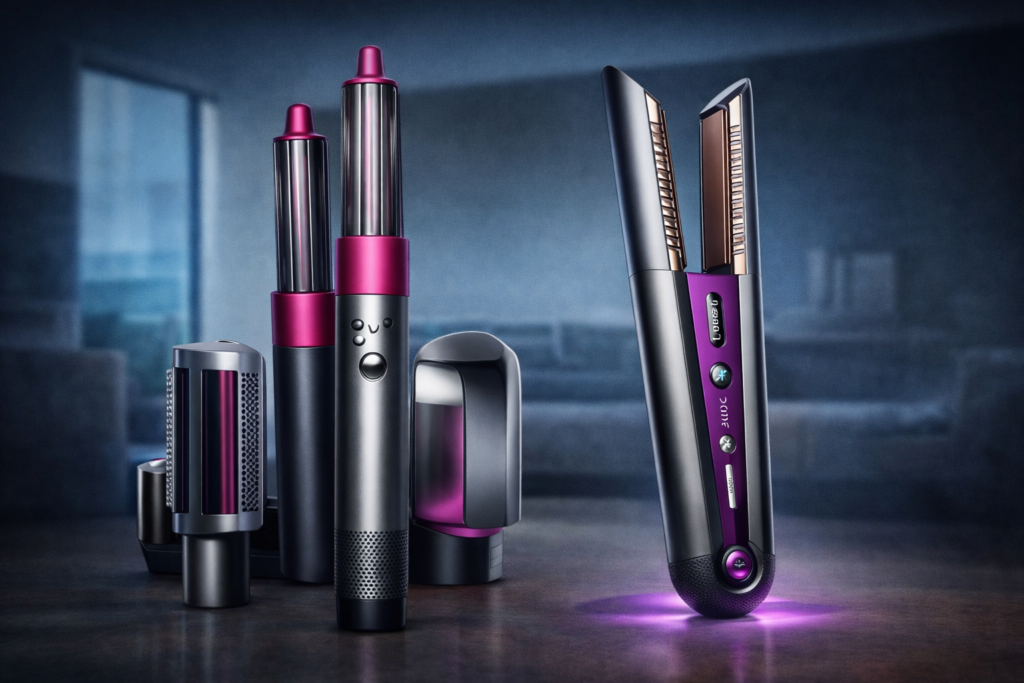
Following the Supersonic, Dyson introduced the Airwrap styler in 2018 and the Corrale straightener in 2020. The Airwrap used the Coanda effect to curl, wave, smooth, and volumize hair without extreme heat, relying on high velocity air to style while protecting hair integrity. This represented a unique convergence of aerodynamics, thermodynamics, and consumer design, staying true to Dyson’s engineering led ethos.
The Corrale straightener further demonstrated Dyson’s commitment to innovation. It featured flexing copper plates, which applied even tension across hair strands, reducing breakage and heat exposure. Both devices incorporated Dyson’s intelligent heat control systems, aligning with the company’s broader goal of improving user safety, performance, and comfort.
These products marked Dyson’s move from functional household engineering to personal luxury appliances, bridging technology, ergonomics, and high end consumer design. By combining precise motor engineering with scientific understanding of heat and airflow, Dyson positioned itself as a brand capable of redefining expectations in multiple consumer sectors simultaneously.
Robotics and Autonomous Innovation of Dyson
Beyond vacuums and haircare, Dyson invested heavily in robotics and autonomous technologies. In 2016, the company launched Dyson 360 Eye, a fully autonomous robotic vacuum cleaner designed to map and clean spaces efficiently. The product featured 360 degree vision, real time mapping, and powerful suction relative to its compact size.
The Dyson 360 Eye exemplified the company’s approach: integrating digital technology, software intelligence, and mechanical engineering. The device’s sensors and navigation system allowed it to adapt to obstacles, furniture layouts, and changing floor conditions, marking Dyson’s entry into AI driven appliances.
While robotics presented significant engineering challenges, including battery constraints, compact motor design, and navigation algorithms, Dyson’s persistence in R&D allowed the company to refine its autonomous technology. This expansion into robotics reflected a broader company vision: that household devices could be smart, autonomous, and intuitively designed for users.
Dyson’s Battery Innovation and Cordless Technology
One of Dyson’s most transformative contributions to appliances was its development of cordless vacuum technology. Starting with the Dyson V6 in 2015 and evolving to the V15 Detect in 2021, Dyson redefined cleaning through high capacity, rechargeable lithium ion batteries paired with digital motors.
Cordless vacuums demanded breakthroughs in energy density, motor efficiency, and heat management. Dyson’s engineers developed Dyson Digital Motors capable of maintaining high suction in a compact, battery powered design. Each iteration improved runtime, power, and filtration while remaining lightweight and user friendly.
The V15 Detect also incorporated laser dust detection, revealing microscopic dust particles invisible to the naked eye. This innovation highlighted Dyson’s continued commitment to merging science, technology, and consumer insights turning ordinary cleaning tasks into precise, engineered experiences.
Dyson’s Sustainability and Environmental Responsibility
In recent years, Dyson has prioritized sustainability across its operations. The company has implemented recyclable materials in its products, reduced energy consumption in manufacturing, and committed to longer product lifespans to minimize waste.
Dyson’s engineers explored battery recycling programs, modular component designs, and initiatives to make devices more repairable. The focus on longevity and sustainability reflects the brand’s philosophy: technology should not only improve lives but also minimize environmental impact.
The company’s global influence in sustainability has encouraged other appliance manufacturers to rethink product design, emphasizing efficiency, material responsibility, and ethical manufacturing practices. Dyson’s approach merges practical environmental considerations with advanced engineering, demonstrating that luxury, performance, and sustainability can coexist.
Dyson Today and Vision for the Future
Today, Dyson is recognized as a global technology leader, with operations spanning household appliances, personal care, robotics, and digital motors. The company maintains its headquarters in the UK and operates research centers in Asia and Europe, emphasizing both innovation and cultural identity.
The company continues to push boundaries in areas like AI driven appliances, autonomous cleaning robots, energy efficient motors, and intelligent personal care devices. Dyson also explores conceptual projects, including electric vehicles, advanced robotics, and next generation air treatment solutions.
James Dyson’s vision remains consistent: every product should solve real world problems through engineering excellence, integrate design with functionality, and enhance user experience. This philosophy ensures that Dyson remains at the forefront of technological innovation, shaping industries and consumer expectations while maintaining a strong cultural and engineering legacy.
Dyson’s journey illustrates that persistence, innovation, and scientific curiosity can turn everyday objects into iconic products, transform industries, and leave a lasting cultural impact. From humble beginnings with bagless vacuum prototypes to luxury personal care devices and robotics, Dyson represents a model of engineering , led creativity that continues to inspire new generations of inventors and designers.
CONCLUSION
Dyson is more than a company, it is a symbol of engineering excellence, innovation, and user focused design. From pioneering the first bagless vacuum to advancing cordless systems, haircare, robotics, and AI technologies, Dyson transforms everyday tools into innovative, practical, and culturally influential devices. Its iterative engineering, commitment to quality, and aesthetic design have shaped global consumer electronics and technology culture. By embracing sustainability, AI, and next generation innovation, Dyson continues to redefine how people live, work, and interact with technology, cementing its role as a leading force in modern design and innovation in https://www.dyson.com/ And streetwear.
Frequently Asked Questions (FAQs) About Dyson
1. Who founded Dyson and when?
Dyson was founded by James Dyson in 1991 after years of inventing and refining the first bagless vacuum cleaner prototypes, revolutionizing the cleaning industry.
2. What is the first major invention of Dyson?
The Dual Cyclone bagless vacuum cleaner was Dyson’s first major invention, eliminating loss of suction and setting a new standard for household cleaning devices.
3. How did Dyson change vacuum technology?
Dyson introduced cyclonic separation technology, advanced motors, and sealed filtration, ensuring constant suction without bags, unlike traditional vacuum cleaners.
4. What are Dyson’s main product categories?
Dyson manufactures vacuum cleaners, haircare products (Supersonic, Airwrap), hand dryers, air purifiers, fans, heaters, lighting, and robotic vacuums, all integrating advanced engineering.
5. What is special about the Dyson Supersonic hair dryer?
The Supersonic features a digital motor in the handle, intelligent heat control, and aerodynamic airflow, protecting hair while delivering fast drying performance.
6. How does the Dyson Airwrap work?
It uses the Coanda effect, high velocity air, and intelligent heat management to curl, smooth, or volumize hair without extreme heat, preserving hair health.
7. What innovations does Dyson cordless vacuum technology include?
Dyson’s cordless vacuums integrate digital motors, high capacity lithium ion batteries, laser dust detection, and intelligent airflow systems for efficient, versatile cleaning.
8. How has Dyson contributed to robotics?
Dyson’s 360 Eye robot vacuum introduced 360 degree vision mapping, AI driven navigation, and autonomous cleaning, reflecting Dyson’s commitment to intelligent household appliances.
9. How does Dyson approach sustainability?
The company uses recyclable materials, modular designs, battery recycling programs, and longer product lifespans to reduce environmental impact while maintaining performance.
10. Where is Dyson headquartered?
Dyson’s headquarters are in Malmesbury, Wiltshire, UK, with research centers in Asia and Europe for global innovation and development.
11. How does Dyson maintain product quality?
Through rigorous prototyping, iterative engineering, and extensive testing, Dyson ensures reliability, performance, and safety across all products.
12. What role does technology play in Dyson appliances?
Dyson integrates digital motors, sensors, AI, temperature control, and smart ergonomics to optimize performance and user experience.
13. Are Dyson products considered luxury appliances?
Yes, Dyson combines engineering, design aesthetics, and advanced functionality, placing products in the premium segment while targeting everyday usability.
14. How has Dyson influenced global design culture?
By blending industrial engineering, minimalistic aesthetics, and functional performance, Dyson has inspired product design, technology expectations, and lifestyle culture worldwide.
15. What is Dyson’s vision for the future?
Dyson aims to expand AI, autonomous systems, personal care innovation, and sustainability initiatives, continuing to solve real world problems with cutting edge technology while shaping the next era of consumer electronics.
For collaborations, press, or inquiries, contact us at streeticonic1@gmail.com.