Sneaker
How Yeezy Changed the Sneaker Industry Forever

How Yeezy Changed the Sneaker Industry Forever is a story about much more than a popular shoe. Yeezy changed how people viewed sneakers, celebrity collaborations, product launches, fashion, and even resale value.
Before Yeezy became a global phenomenon, sneakers were already an important part of streetwear. Jordan, Nike, adidas, Reebok, and other brands had established powerful communities around footwear. But Kanye West brought something different: a fashion driven creative vision combined with celebrity influence, scarcity, social media attention, and performance technology.
The result was a new kind of Yeezy sneaker that could sit comfortably between sportswear, luxury fashion, and street culture.
The most important change was simple: Yeezy helped turn the sneaker from something people wore into something people followed, discussed, collected, traded, and used as a form of personal identity.


How Yeezy Changed the Sneaker Industry Forever
Yeezy’s influence came from several forces working together rather than one revolutionary shoe.
Kanye West understood that a sneaker could be treated like a cultural product. adidas supplied manufacturing expertise and technologies such as BOOST cushioning, while West supplied an unmistakable visual direction and enormous cultural reach.
In 2016, adidas described the expanded adidas and Kanye West partnership as the most significant partnership it had created with a non athlete. The company also highlighted the success of the Yeezy Boost 750 and Yeezy Boost 350.
That distinction matters. Yeezy was not simply a celebrity putting his name on an existing shoe. The collaboration became a product universe with its own design language.
From Nike Air Yeezy to adidas Yeezy
The Yeezy story actually began before adidas.
West’s Nike relationship produced the Air Yeezy and Air Yeezy II. The shoes demonstrated that a musician could create enormous demand for footwear without being a professional athlete.
That was a major shift.
Traditionally, signature sneakers were strongly connected to athletic achievement. Yeezy showed that cultural influence could be equally powerful.
By the time West moved to adidas, the basic idea had already been tested. The adidas partnership gave that idea greater scale and a broader creative framework.
Forbes later described the Yeezy business as a serious commercial rival to established sneaker empires, reporting estimated Yeezy sales of about $1.3 billion in 2019 and $1.7 billion in 2020.
Why Yeezy’s Design Language Was So Different
One of the biggest reasons Yeezy succeeded was its refusal to follow conventional sneaker aesthetics.
Many traditional sneakers relied heavily on visible logos, bright colors, athletic detailing, and recognizable brand signatures. Yeezy often moved in the opposite direction.
Its design language favored:
- Neutral and earthy colors
- Minimal branding
- Sculptural shapes
- Oversized or unconventional proportions
- Knit materials
- Futuristic silhouettes
- Comfortable everyday construction
The Yeezy Boost 350 became particularly important because it combined adidas BOOST cushioning with Primeknit construction and West’s minimalist design approach. adidas itself described the model as one of its fastest selling and most sought after footwear products at the time.
This combination made the shoe accessible visually while still feeling different.
That balance was crucial.
A sneaker could look unusual enough to attract attention but simple enough to wear with jeans, sweatpants, oversized hoodies, or tailored clothing.
Yeezy Made Minimalism Mainstream
Yeezy also helped normalize muted sneaker palettes.
Bone, cream, gray, brown, black, and other understated colors became increasingly important in contemporary footwear. Instead of using color to make a sneaker exciting, designers could rely on shape, texture, proportion, and material.
This approach influenced the broader fashion conversation.
The Yeezy aesthetic became recognizable even when the branding was barely visible.
That is one of the clearest signs of successful design: people could identify the product through its silhouette rather than its logo.

How Yeezy Changed Sneaker Drops and Hype Culture
Yeezy did not invent limited releases, but it helped turn scarcity into a central part of sneaker marketing.
A release could become an event before customers even saw the product in person.
The basic formula was powerful:
- Announce a new colorway or model.
- Build anticipation through social media and celebrity visibility.
- Release limited quantities.
- Allow demand to exceed immediate supply.
- Watch the conversation move to resale platforms.
- Use that resale activity to reinforce the product’s cultural value.
This created a feedback loop.
When people saw a Yeezy sneaker selling quickly, the product appeared more desirable. When resale prices climbed, the original retail price seemed relatively accessible. When buyers posted their pairs online, they generated additional exposure.
In other words, the customer became part of the marketing system.
The Rise of the Resale Mindset
Yeezy helped accelerate the idea that buying sneakers could involve two questions:
Do I want to wear this?
and
What will this be worth later?
That mentality became particularly important as sneaker resale platforms grew.
A successful release was no longer measured only by units sold through traditional retail. Online discussion, search demand, resale activity, social posts, and aftermarket prices all contributed to the perceived success of a drop.
Some Yeezy models became especially desirable among collectors, while others became more accessible as production expanded.
This evolution also changed how consumers approached future sneaker releases from other brands.
Which Yeezy Models Changed Sneaker Culture?
Yeezy’s influence was not limited to one silhouette. Several models helped push sneaker design in different directions.
Yeezy Boost 750
The Yeezy Boost 750 was the first major adidas and West product. Its high top construction, zipper detail, and BOOST cushioning gave it a distinctive luxury inspired appearance.
It established the visual foundation for the partnership and demonstrated that performance technology could coexist with fashion focused design.
Yeezy Boost 350
The 350 was arguably the most important model for mainstream adoption.
Its low profile made it easier to wear than the 750, while the Primeknit upper and BOOST sole provided a modern technical feel.
The model showed that a relatively simple sneaker could become a major cultural product when design, scarcity, celebrity influence, and distribution were coordinated effectively.
Yeezy Boost 350 V2
The 350 V2 pushed the formula further with recognizable side stripes, changing color combinations, and repeated releases.
Its accessibility also demonstrated an important evolution in Yeezy strategy.
The brand could preserve hype while reaching a larger audience.
In 2018, adidas described the Yeezy Boost 350 V2 Triple White release as its biggest digital Yeezy release to that point, saying it generated millions of visits to adidas.com and exceeded previous Yeezy releases in media mentions and search interest.
That is a useful example of how Yeezy became more than a footwear product. A sneaker launch could become a digital traffic engine.
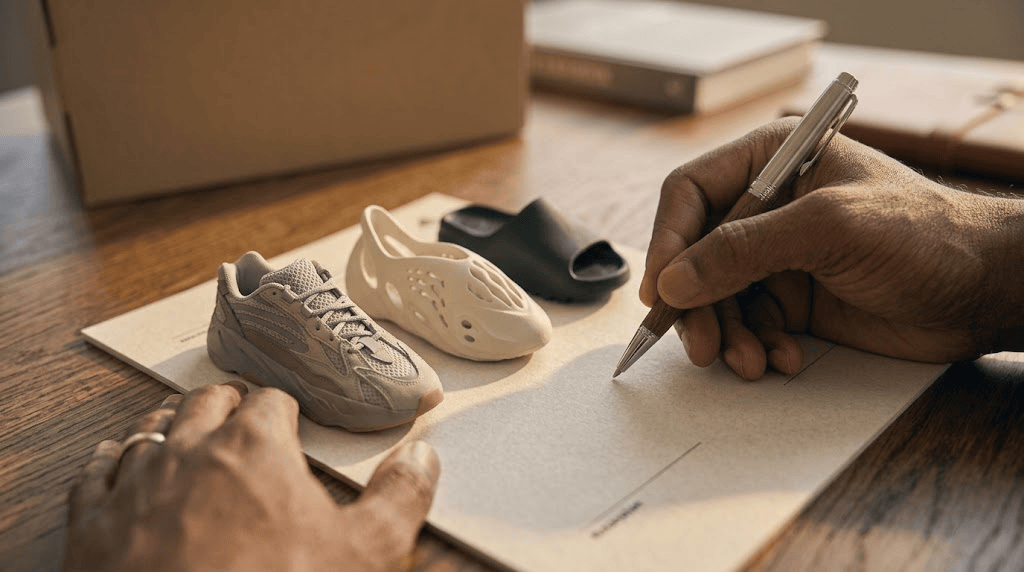
Yeezy 700
The Yeezy 700 helped popularize the chunky, retro inspired running sneaker aesthetic.
Its layered upper and substantial midsole fit into the broader movement toward oversized footwear.
The popularity of the 700 also demonstrated that Yeezy customers were willing to embrace designs that looked very different from traditional minimalist sneakers.
Yeezy Foam Runner and Slides
Later products pushed the concept even further.
The Foam Runner moved away from conventional sneaker construction altogether, using a molded foam form with a highly recognizable shape.
The Yeezy Slide took a similarly simple approach.
These products helped demonstrate that a successful footwear brand did not need to keep making traditional lace up sneakers.
Yeezy Changed the Relationship Between Celebrity and Brands
Perhaps Yeezy’s biggest business lesson was the changing role of the celebrity collaborator.
A celebrity endorsement traditionally meant that a famous person promoted a product created primarily by the company.
Yeezy moved toward a different model.
The creator became part of the product’s identity.
That distinction influenced later collaborations throughout fashion and footwear. Artists, designers, athletes, musicians, and entertainers increasingly became creative partners rather than simply advertising faces.
adidas itself described the expanded Yeezy partnership as a collaboration spanning footwear, apparel, and accessories, showing how far the relationship extended beyond a conventional signature shoe.
The model was commercially powerful because West brought an existing audience while adidas brought infrastructure.
That combination reduced the distance between entertainment, fashion, and sportswear.
The Creator Became the Brand
Yeezy also demonstrated the risk of putting too much brand power behind one individual.
The same personality that generated attention could also create reputational risk.
This became impossible to ignore in 2022, when adidas terminated its partnership with West.
The company subsequently stopped distributing Yeezy products and stopped payments to West and his companies.
The business consequences were substantial.
adidas reported that Yeezy revenue exceeded €1.2 billion in 2022. In 2023, remaining Yeezy product drops generated approximately €750 million in revenue.
By the end of 2024, adidas reported that it no longer held Yeezy products, after generating about €650 million from remaining inventory during that year.
The lesson is important: cultural relevance can create extraordinary commercial value, but it also creates extraordinary dependency.
What Did Yeezy Teach the Sneaker Industry?
Yeezy’s legacy extends beyond the products themselves.
1. Design Can Matter More Than Logos
Yeezy proved that a sneaker can become recognizable through shape, materials, and color rather than prominent branding.
2. Scarcity Can Create Conversation
Limited releases made consumers pay attention before they ever entered a store.
3. Digital Marketing Can Become Part of the Product
The 2018 350 V2 Triple White release generated millions of visits to adidas.com, demonstrating how a sneaker launch could influence an entire digital ecosystem.
4. Celebrity Collaborations Can Become Businesses
Yeezy showed that a creator partnership could grow into a substantial commercial operation rather than remaining a marketing campaign.
5. Resale Can Strengthen Primary Demand
Secondary market activity helped transform sneakers into cultural assets whose value extended beyond their original retail transaction.
6. Innovation Does Not Always Mean Performance Innovation
Yeezy’s innovations were often visual, cultural, commercial, and distribution focused.
That is a major reason its influence reached fashion brands that were not competing directly in athletic footwear.
The Original Insight: Yeezy Changed What a Sneaker Launch Meant
The most important part of the Yeezy story is not simply that the shoes sold well.
It is that Yeezy changed the unit of attention in the sneaker business.
Before the Yeezy era, the primary event was often the shoe itself. With Yeezy, the entire sequence became the event: the rumor, announcement, celebrity appearance, product photos, release date, online queue, sellout, resale listings, outfit posts, and discussions afterward.
That created an unusually long marketing lifecycle around a single product.
Consider the 2018 Yeezy Boost 350 V2 Triple White release. adidas said the release drove millions of visits to its website and surpassed earlier Yeezy launches in search interest and media mentions.
My seven years of experience studying fashion and ecommerce content reinforces why this matters: the strongest product stories rarely depend on one sales moment. Yeezy created a story that could be searched, shared, debated, collected, and revisited long after release day.
That is the blueprint many modern sneaker launches still follow.
Is Yeezy Still Influential in 2026?
Yes, although the business relationship with adidas has ended.
The adidas Yeezy partnership was terminated in October 2022, and adidas later sold remaining inventory through 2023 and 2024.
But ending a partnership does not erase its influence.
Yeezy’s impact can still be seen in:
- Minimalist sneaker design
- Neutral color palettes
- Chunky footwear
- Foam based construction
- Limited product releases
- Creator led collaborations
- Sneaker resale culture
- Social media driven launches
- The blending of luxury and sportswear
- Consumers treating footwear as collectible fashion
The interesting point is that Yeezy no longer needs to dominate sales to remain influential.
Its design language and marketing model have already entered the broader sneaker vocabulary.
What Is the Lasting Legacy of Yeezy?
Yeezy’s legacy is complicated.
It represents creative ambition, commercial success, design experimentation, and a new approach to celebrity partnerships. It also demonstrates the risks of building a major business around a single public figure.
For sneaker culture, however, the influence is clear.
Yeezy helped make sneakers central to contemporary fashion rather than treating them as a separate category of casual footwear. It showed brands that a sneaker could be discussed like fashion, marketed like entertainment, sold like a collectible, and evaluated like an investment.
The adidas partnership produced more than successful shoes. It created a template.
And that template continues to influence how brands build anticipation, collaborate with creators, design products, and communicate with consumers.
Conclusion: Why Yeezy Changed Sneakers Forever
How Yeezy Changed the Sneaker Industry Forever comes down to one fundamental transformation: Yeezy helped turn footwear into a cultural experience.
From the early Air Yeezy era to adidas’s Yeezy Boost 750, 350, 700, Foam Runner, and Slides, the brand repeatedly challenged traditional ideas about what sneakers should look like and how they should be sold.
Its influence reached design, streetwear, celebrity marketing, social media, resale culture, and the relationship between fashion and sportswear.
The adidas partnership ultimately ended, but the industry’s response to Yeezy did not.
Yeezy’s greatest legacy may be that it changed what consumers expect from a sneaker launch.
A sneaker is no longer just something to wear. It can be a story, a status symbol, a collectible, a cultural statement, and a digital event all at once.
For more fashion and sneaker insights, explore [INTERNAL LINK: our latest streetwear and sneaker guides].
FAQ Section
How did Yeezy change the sneaker industry?
Yeezy changed the sneaker industry by combining celebrity influence, distinctive design, limited releases, social media attention, and resale culture. It helped make sneakers a central part of modern fashion and entertainment.
Why was the Yeezy Boost 350 so popular?
The Yeezy Boost 350 combined a minimalist silhouette with adidas BOOST cushioning, Primeknit construction, recognizable styling, and strong demand created through limited releases and Kanye West’s cultural influence.
Did Yeezy influence sneaker resale culture?
Yes. Yeezy contributed significantly to the growth of the modern sneaker resale mindset by making limited releases highly desirable and encouraging consumers to view sneakers as both fashion products and potentially valuable collectibles.
When did adidas end its Yeezy partnership?
adidas terminated its partnership with Kanye West in October 2022 and discontinued the distribution of Yeezy products.
Is Yeezy still influential today?
Yes. Even after the adidas partnership ended, Yeezy’s minimalist design language, neutral colors, unusual silhouettes, creator led collaboration model, and approach to product launches continue to influence sneaker and streetwear culture.
What is Yeezy’s biggest contribution to sneaker culture?
Its biggest contribution was helping merge sneakers with fashion, celebrity culture, digital marketing, and resale. Yeezy demonstrated that a sneaker could become a cultural event rather than simply another footwear release.