Style Guides
How to Build a Capsule Streetwear Wardrobe in 2026

How to Build a Capsule Streetwear Wardrobe starts with one simple idea: buy fewer pieces that work harder together. Instead of filling your closet with every trend, build a compact rotation of reliable basics, strong silhouettes, versatile footwear, and a few pieces that show your personality.
A good capsule streetwear wardrobe should not feel boring or restrictive. That is where many traditional capsule wardrobe guides miss the point. Streetwear depends heavily on proportion, layering, graphics, footwear, texture, and personal expression.
The goal is not to own exactly 20 or 30 pieces. The goal is to make almost everything in your closet useful.
Start with a neutral color foundation, choose 2 to 3 dependable bottoms, 5 to 7 versatile tops, 2 to 3 layers, 2 to 3 pairs of shoes, and one or two statement pieces. Then test your combinations before buying anything else.


What Is a Capsule Streetwear Wardrobe?
A capsule streetwear wardrobe is a deliberately limited collection of clothing designed to create many outfits from relatively few pieces.
Traditional capsule wardrobes often focus on timeless basics. Streetwear adds another dimension: personality.
That means your capsule can include:
- Oversized or relaxed T shirts
- Hoodies and crewnecks
- Cargo or work pants
- Straight or relaxed denim
- Lightweight jackets
- A warmer seasonal jacket
- Sneakers
- Caps and bags
- Jewelry
- One or two statement pieces
The important part is compatibility.
A graphic hoodie that only works with one pair of pants is not particularly useful in a capsule. A hoodie that works with denim, cargos, and relaxed trousers gives you far more styling options.
The Sole Supplier similarly emphasizes interchangeable pieces, neutral colors, versatile layers, and footwear as the foundation of a streetwear capsule.
How to Build a Capsule Streetwear Wardrobe Step by Step
1. Define Your Streetwear Style First
Before buying clothes, identify what kind of streetwear you actually wear.
Streetwear is broad. Your wardrobe might lean toward:
- Minimalist streetwear
- Skate inspired outfits
- Workwear streetwear
- Athletic streetwear
- Vintage streetwear
- Techwear influenced looks
- Luxury streetwear
- Y2K inspired outfits
You do not need to choose only one category.
Instead, identify your common visual language.
For example, you might prefer:
Colors: black, charcoal, cream, olive and faded blue
Fit: relaxed tops with straight or wide pants
Shoes: low profile sneakers and retro runners
Graphics: small logos and occasional bold prints
Outerwear: workwear jackets and lightweight technical layers
That description becomes your buying filter.
If a new item does not fit your preferred colors, proportions, or lifestyle, you have a reason to leave it behind.
2. Choose a Simple Color Palette
Color coordination is one of the easiest ways to make a small wardrobe feel much larger.
Start with two or three core neutrals.
Good choices include:
- Black
- White
- Grey
- Navy
- Cream
- Brown
- Olive
- Khaki
Then introduce one accent color if you want more personality.
For example:
Core: black, grey and cream
Accent: burgundy
Or:
Core: navy, white and olive
Accent: faded red
You do not need every item to be neutral. A capsule works better when your foundation is easy to combine and your standout colors are intentional.
Traditional capsule wardrobe guides also emphasize neutral colors because they make more combinations possible.
3. Build Your T Shirt Rotation
T shirts are the foundation of most casual streetwear outfits.
A practical starting point is around five to seven shirts.
Try a combination such as:
- 2 black T shirts
- 1 white T shirt
- 1 grey or heather T shirt
- 1 cream or off white T shirt
- 1 graphic T shirt
- 1 seasonal or experimental T shirt
Focus on fit before branding.
A slightly oversized shirt can create a completely different silhouette from a regular fit shirt even when both are the same color.
Look for:
- Comfortable shoulder width
- Appropriate body length
- Fabric that holds its shape
- A neckline that does not collapse quickly
- A fit that works underneath your outer layers
The best T shirt is not necessarily the most expensive one. It is the one you repeatedly reach for.
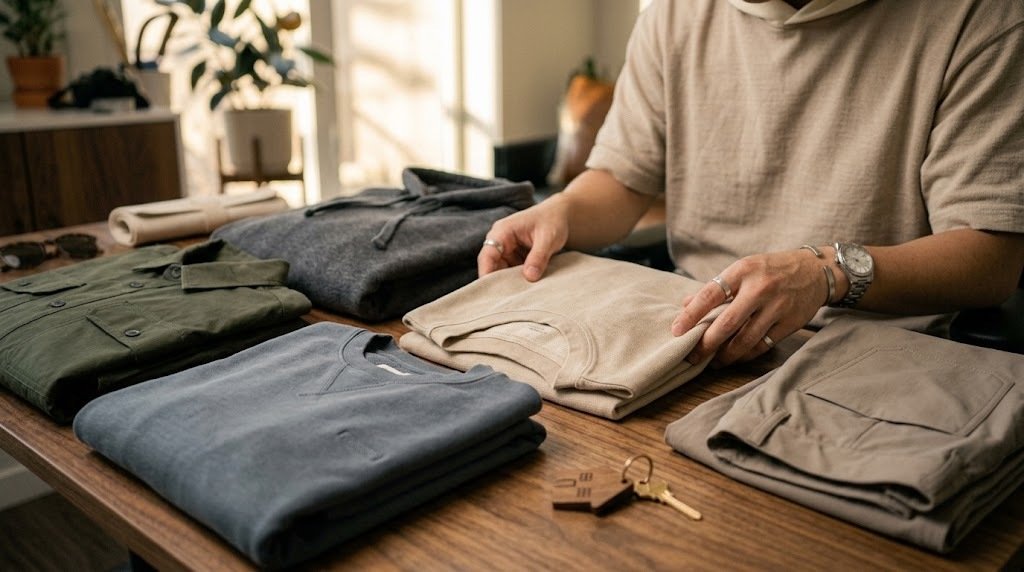
4. Add Hoodies, Crewnecks and Overshirts
Your middle layers create much of the visual identity of a capsule streetwear wardrobe.
A strong starting combination is:
One hoodie + one crewneck + one overshirt.
For example:
- Black heavyweight hoodie
- Grey crewneck sweatshirt
- Olive overshirt
This gives you three different silhouettes without creating unnecessary duplication.
You can also replace the overshirt with a zip hoodie, cardigan, fleece or knit depending on your climate and style.
The key is to avoid owning five versions of the same layer unless you genuinely wear them.
The Sole Supplier recommends hoodies, crewnecks and overshirts as major upper layers, while other capsule guides emphasize versatility and interchangeable construction.
5. Choose 3 Core Bottoms
Your pants determine the proportions of your outfit, so do not treat them as an afterthought.
A useful three piece starting point is:
1. Relaxed denim
Choose a medium, dark or faded wash depending on your wardrobe.
2. Cargo or work pants
Olive, black, brown or charcoal works well.
3. Straight or relaxed trousers
These give your wardrobe a cleaner option and help balance oversized tops.
You can adjust the formula based on your lifestyle.
If you live in denim, own two different jeans and one cargo. If cargos are your everyday choice, reverse the ratio.
The important thing is silhouette variety.
Three pairs of pants that all fit exactly the same way will not give you much visual variety.
6. Build Around Two or Three Jackets
Outerwear can transform a simple outfit, which makes it especially valuable in streetwear.
For a flexible US wardrobe, consider:
Light layer: coach jacket, overshirt, denim jacket, bomber or windbreaker.
Cold weather layer: puffer, parka, insulated workwear jacket or wool coat.
Optional statement layer: varsity jacket, technical shell, leather jacket or distinctive workwear piece.
Your local climate matters here.
Someone in Los Angeles may get more value from lightweight jackets and overshirts. Someone in Chicago or Minneapolis needs serious winter outerwear. Someone in the Pacific Northwest may prioritize water resistant layers.
Do not copy another person’s capsule exactly. Build around the weather you actually experience.
MR PORTER’s recent capsule guide also highlights lightweight jackets as versatile seasonal layers, alongside sneakers, jeans and other adaptable staples.
What Shoes Should Be in a Capsule Streetwear Wardrobe?
Shoes can change the entire character of an outfit, so a capsule streetwear rotation should include different functions rather than several nearly identical sneakers.
A useful three shoe rotation is:
Everyday Sneakers
Choose a pair that works with most of your pants.
White, black, grey or neutral sneakers are usually easy starting points.
Statement or Retro Sneakers
This is where you can introduce more personality.
Think about:
- Retro running silhouettes
- Basketball inspired sneakers
- Skate shoes
- Chunkier sneakers
- Distinctive color combinations
Boots, Loafers or Comfortable Casual Shoes
The third category depends on your lifestyle.
Boots work well with workwear and winter outfits. Loafers can give streetwear a more polished direction. Comfortable runners can be useful if you spend most of your day walking.
The important rule is simple:
Do not buy shoes only because they look good alone. Buy shoes that complete multiple outfits you already own.
How Many Pieces Should a Capsule Streetwear Wardrobe Have?
There is no universal number.
A useful starting point for a single season is around 20 to 30 clothing and footwear pieces, excluding underwear, sleepwear and specialized sportswear.
For example:
| Category | Starting Amount |
|---|---|
| T shirts | 5 to 7 |
| Hoodies and sweatshirts | 2 to 3 |
| Overshirts or mid layers | 1 to 2 |
| Pants | 3 |
| Jackets | 2 |
| Sneakers and shoes | 2 to 3 |
| Accessories | 3 to 5 |
Think of this as a framework, not a rule.
If you wash clothes frequently, you may need fewer T shirts. If you work outdoors, you may need additional layers. If you live somewhere with four distinct seasons, you may rotate seasonal capsules.
A capsule should fit your life, not the other way around.
How to Keep Capsule Streetwear From Getting Boring
This is the biggest weakness of many minimalist wardrobe approaches.
If every item is black, grey or white and every silhouette is basic, your wardrobe can become predictable.
The solution is not to buy more clothes.
The solution is to create controlled variety.
Use the 80/20 Rule
A useful personal rule is:
80% versatile pieces + 20% personality pieces.
Your versatile pieces might include:
- Plain T shirts
- Relaxed denim
- Cargo pants
- Neutral hoodies
- Simple sneakers
- Basic jackets
Your personality pieces could include:
- Graphic hoodie
- Vintage jacket
- Bold sneaker
- Distinctive bag
- Interesting knit
- Statement accessory
This approach keeps your wardrobe practical without making it lifeless.
Interestingly, an old streetwear community discussion reached a similar conclusion: use simple interchangeable pieces as the foundation and allow a smaller number of louder or unusual pieces to provide personality.
Change the Silhouette
You can make the same clothes feel different by changing proportions.
Try:
Oversized hoodie + straight denim + slim sneaker
Then:
Fitted T shirt + wide cargo pants + chunky sneaker
Then:
Cropped jacket + relaxed trousers + low profile sneaker
The garments can remain almost identical while the visual balance changes.
This is one of the most effective ways to expand outfit possibilities without expanding your closet.
Use Texture Instead of More Color
If you prefer a neutral wardrobe, add interest through materials.
Try combining:
- Washed denim
- Heavy cotton
- Nylon
- Fleece
- Corduroy
- Wool
- Leather
A black cotton hoodie and black nylon jacket can look completely different even though both are black.
How to Shop for a Capsule Streetwear Wardrobe
The smartest capsule wardrobes are built slowly.
Do not attempt to purchase everything in one weekend.
Start with your biggest wardrobe gap.
For example:
Problem: You own plenty of T shirts but have nothing suitable for cold evenings.
Purchase: A versatile jacket.
Or:
Problem: Your outfits all use the same black jeans.
Purchase: Relaxed olive cargos.
Or:
Problem: Your wardrobe feels too basic.
Purchase: One statement piece instead of five random trend items.
MEXESS makes a similar point in its capsule guidance: build gradually, wear the initial pieces, identify what is actually missing, and then make the next purchase.
Use the Three Outfit Test
Before buying an item, try to create at least three outfits using clothes you already own.
For example, a new olive overshirt should work with:
- White T shirt + black cargos + sneakers
- Grey hoodie + blue denim + sneakers
- Black T shirt + cream trousers + boots
If you cannot create three convincing outfits, pause before buying.
This is one of the simplest ways to prevent a capsule wardrobe from turning into a collection of isolated outfits.
Think Cost Per Wear
A $150 jacket worn 75 times costs about $2 per wear.
A $50 jacket worn twice costs $25 per wear.
Price still matters, but purchase value should be judged by how often a garment will realistically enter your rotation.
Quality also matters, especially for frequently worn basics. Look at fabric weight, stitching, construction, hardware, fit and care requirements rather than relying only on the brand name.
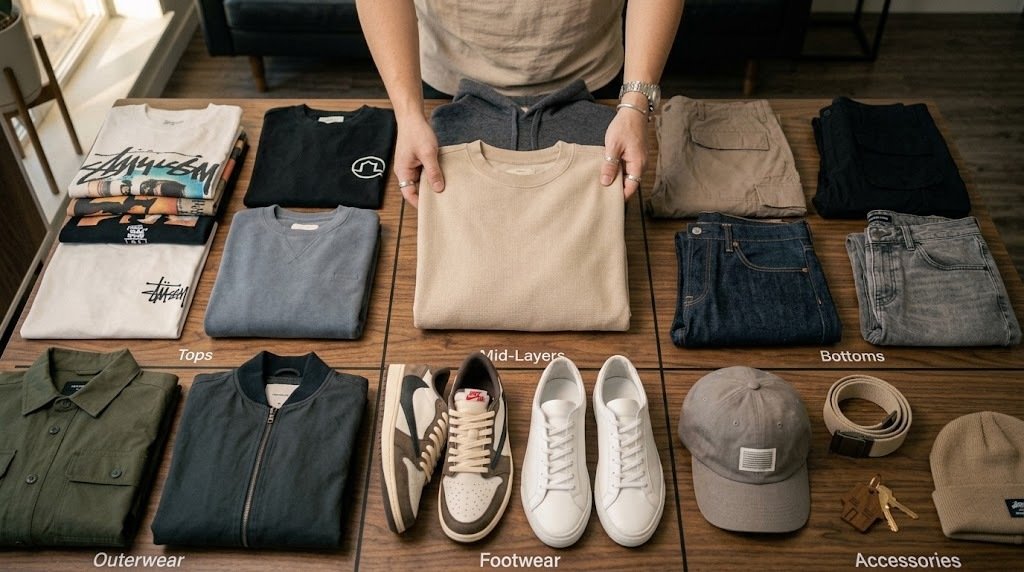
A Sample 25 Piece Capsule Streetwear Wardrobe
Here is a practical example you can adapt.
Tops
- 2 black T shirts
- 1 white T shirt
- 1 grey T shirt
- 1 cream T shirt
- 1 graphic T shirt
- 1 long sleeve T shirt
Middle Layers
- 1 black hoodie
- 1 grey crewneck
- 1 olive overshirt
Bottoms
- 1 relaxed blue denim
- 1 black denim
- 1 olive cargo pant
- 1 charcoal relaxed trouser
Outerwear
- 1 lightweight jacket
- 1 warm winter jacket
Footwear
- 1 everyday neutral sneaker
- 1 statement sneaker
- 1 boot or loafer
Accessories
- 1 baseball cap
- 1 crossbody or shoulder bag
- 1 simple chain
- 1 belt
That gives you a compact wardrobe with enough variation for casual days, social plans, colder weather and more polished streetwear combinations.
How to Make a Capsule Streetwear Wardrobe Work Year Round
Instead of replacing your entire closet every season, rotate a few pieces.
Spring
Prioritize:
- Lightweight jackets
- Long sleeve shirts
- Lighter denim
- Sneakers
- Overshirts
Summer
Prioritize:
- Breathable T shirts
- Shorts
- Lightweight trousers
- Canvas or mesh sneakers
- Caps
Fall
Bring back:
- Hoodies
- Crewnecks
- Overshirts
- Denim jackets
- Heavier pants
Winter
Focus on:
- Insulated outerwear
- Layering pieces
- Heavy hoodies
- Knitwear
- Boots
- Warm accessories
This seasonal rotation lets you maintain a smaller core wardrobe while still changing your look throughout the year.
Common Capsule Streetwear Mistakes to Avoid
Buying Only Basics
A wardrobe made entirely of plain black and grey garments can become boring.
Keep a few pieces that express your personality.
Chasing Every Trend
Streetwear changes quickly. Buying every viral silhouette can leave you with clothes you stop wearing after one season.
Use trends as inspiration rather than instructions.
Ignoring Fit
A $200 hoodie with poor proportions will not improve an outfit.
Fit and silhouette often matter more than the logo.
Owning Too Many Similar Pieces
Five black hoodies may sound useful until you realize you regularly wear only two.
Buy variety in function, texture and silhouette.
Forgetting Your Lifestyle
A wardrobe should reflect where you actually go.
If you walk everywhere, footwear deserves more attention. If you work in an office, include a cleaner trouser or jacket. If winters are severe, prioritize outerwear.
The Best Capsule Streetwear Formula for 2026
If you want a simple starting formula, use this:
5 to 7 T shirts + 2 to 3 mid layers + 3 to 4 pants + 2 jackets + 2 to 3 shoes + 3 to 5 accessories + 1 to 2 statement pieces.
Then stop.
Wear the wardrobe for several weeks before buying anything else.
Pay attention to what you repeatedly reach for. Those pieces tell you more about your personal style than a saved social media post ever will.
The strongest capsule streetwear wardrobes are not the ones with the fewest clothes. They are the ones where the owner understands why every piece is there.
Conclusion: Build Less, Style More
Learning How to Build a Capsule Streetwear Wardrobe is really about becoming more intentional with what you buy.
Start with versatile colors. Choose silhouettes that suit your body and lifestyle. Build around dependable T shirts, hoodies, pants, outerwear and sneakers. Then add a small number of statement pieces that make the wardrobe feel like yours.
Most importantly, do not rush.
Buy a piece, wear it, test it with your existing clothes and see what your wardrobe actually needs next.
A good capsule does not make streetwear boring. It gives your best pieces more opportunities to stand out.
FAQ Section
How many pieces should be in a capsule streetwear wardrobe?
There is no fixed number, but around 20 to 30 clothing and footwear pieces is a practical starting point for a seasonal capsule. Adjust the number based on your climate, lifestyle, laundry routine and personal style.
What colors are best for capsule streetwear?
Black, white, grey, cream, navy, olive, brown and khaki are strong foundation colors because they are easy to combine. Add one or two accent colors if you want more personality.
Can a capsule wardrobe still include graphic streetwear?
Yes. A capsule streetwear wardrobe should include some personality. Keep most pieces versatile and use one or two graphic or statement items to create visual variety.
What shoes should I include in a streetwear capsule?
Start with an everyday neutral sneaker and a second pair with more personality. A third option can be boots, loafers or comfortable runners depending on your lifestyle and climate.
How do I stop a capsule streetwear wardrobe from becoming boring?
Use different silhouettes, textures, layers and footwear instead of simply buying more clothes. An 80/20 balance of versatile basics and statement pieces is a useful starting point.
Should I buy everything for my capsule wardrobe at once?
No. Build it gradually. Wear your initial pieces for several weeks and identify genuine gaps before making additional purchases. This reduces impulse buying and creates a wardrobe based on your real habits.