
Brands
Banpresto — A Complete Guide to Japan’s Leading Anime Collectible Brand


Banpresto is a leading name in the anime collectibles market. The brand has been active for several decades. It focuses on turning popular anime characters into physical figures. It also creates figures based on manga series. Video game characters are also part of its product lineup. These figures allow fans to own their favorite characters. Fans can display these figures with pride. Many collectors emotionally connect with these products. Banpresto is known for its affordable pricing. The brand produces officially licensed merchandise. This strategy has helped anime collectibles become mainstream.
Many figure manufacturers focus only on high-end collectors. Banpresto follows a different approach. The brand targets mass-market appeal. Its products are designed for a wide audience. First-time buyers are an important customer group. Experienced collectors are also considered. Some collectors have been buying figures for many years. This inclusive strategy has strengthened Banpresto’s global presence.

Banpresto is a subsidiary of Bandai Namco Holdings. Bandai Namco is a major entertainment company in Japan. The parent company owns world-famous intellectual properties. Banpresto benefits from access to these licenses. It also benefits from a global distribution network. This allows the brand to reach international markets. Banpresto continues to influence anime culture worldwide. It shapes how fans experience anime through collectibles.
The Origins of Banpresto
Banpresto was established in Japan in 1977. This period marked rapid growth in Japan’s entertainment industry. The gaming sector was also expanding quickly. In its early years, Banpresto focused on amusement-related products. These products were designed for entertainment centers. The company produced prizes for arcade games. It also created novelty items. Promotional merchandise was another product category.
At the same time, Japan’s arcade scene was growing fast. Crane games were becoming widely popular. Prize machines attracted large numbers of players. Young people were especially drawn to these games. Banpresto identified this trend early. The company positioned itself as a prize supplier. Its prizes were designed to be desirable. The collectibles encouraged repeat play.
In the 1980s, anime and manga gained popularity. Banpresto shifted its focus toward character-based merchandise. This shift became a turning point in the company’s history. The brand partnered with popular anime properties. This move expanded Banpresto’s creative direction. The company moved beyond simple novelty items. It entered the licensed collectibles market. This marked the beginning of a new era for Banpresto.
Banpresto’s Growth and Evolution
In the 1990s and early 2000s, Banpresto continued to grow steadily. Popular anime series gained worldwide recognition during this period. Franchises like Dragon Ball, One Piece, and Naruto became global hits. Fans around the world began demanding official merchandise. Banpresto recognized this growing demand early. The company responded by creating accessible figures. These figures were easy to recognize. They were also widely distributed.
Banpresto’s arcade prize business model supported large-scale distribution. A massive number of figures were released across Japan. These figures later reached retail stores. Importers helped move products overseas. This process expanded Banpresto’s reach beyond Japan. The brand gained a broader international audience.
A major turning point came in 2008. Banpresto was acquired by Bandai Namco Holdings. This acquisition strengthened licensing opportunities. It improved manufacturing capabilities. Global distribution networks also expanded. Banpresto continued refining its figure lines. The company remained committed to affordability and accessibility.
Banpresto’s Design Philosophy
Banpresto’s design philosophy is built on accuracy. It also focuses on emotional recognition. The figures closely match their anime versions. Game appearances are also carefully followed. This allows fans to instantly recognize each character. The associated story is also easily recalled.
Banpresto does not aim for extreme realism. The focus remains on clean sculpting. Dynamic poses are an important element. Good proportions are carefully maintained. Each figure captures an iconic moment. Facial expressions play a key role. Costumes add to character identity. Poses help convey the scene.
Action poses are especially common. This is true for battle-focused series. These poses suggest movement and energy. The figures feel lively and engaging. This appeal remains strong despite lower pricing. This balance helps Banpresto stand out. The brand remains competitive in a crowded market.
Product Categories and Figure Lines
Banpresto offers a diverse range of figure lines designed to meet different collector preferences.
Prize Figures
Prize figures are Banpresto’s most recognizable products. Originally created for arcade crane games, these figures combine affordability with strong visual appeal. Despite being prize items, many feature impressive sculpt quality.
DXF Figures
DXF figures focus on balanced proportions and clean presentation. They are often used to represent main characters in iconic outfits.
Grandista
Grandista figures are larger in size and emphasize realism and presence. These figures are popular among collectors who prefer display-focused pieces.
Q Posket
Q Posket figures feature stylized, chibi-inspired designs with large eyes and softer expressions. This line appeals to fans who enjoy cute and decorative aesthetics.
World Collectable Figure (WCF)
WCF figures are small, detailed collectibles designed to represent entire character rosters. They are highly popular among completionist collectors.
Major Anime Franchises Covered by Banpresto

Banpresto holds licenses for many of the most successful franchises in anime and gaming history, including:
• Dragon Ball
• One Piece
• Naruto
• Demon Slayer
• My Hero Academia
• Jujutsu Kaisen
• Pokémon
• Attack on Titan
• Bleach
By consistently updating its releases to match new anime seasons, movies, and anniversaries, Banpresto remains aligned with current fan interests.
Banpresto and Anime Culture
Banpresto has been instrumental in making anime merchandise a part of everyday life. In Japan, the prize figures found in arcades normalized the notion that anime merchandise was a part of entertainment culture, as opposed to being a hobby.
Worldwide, Banpresto figures are usually the first point of contact for a collector who is interested in anime merchandise.
Collaborations and Presence
Banpresto, a Bandai Namco subsidiary, collaborates with major anime, manga, and gaming franchises to produce high-quality prize figures. Key projects include Gundam 45th Anniversary x Hatsune Miku, Dragon Ball Dokkan Battle and Legends, One Piece, VIBRATION STARS (Demon Slayer, Naruto, Chainsaw Man), and Mangart BeamsT figures like Master Roshi. These partnerships create limited-run, intricately designed collectibles that are highly sought after by fans worldwide.
Quality and Affordability Balance
One of the defining characteristics of Banpresto is its ability to strike a balance between cost and quality. Although it is not a high-end brand, it still manages to provide good sculpting, high-quality materials, and precise designs.
This makes it possible for collectors to create massive displays without having to break the bank. Many collectors use Banpresto figures to fill in the gaps of their premium statues or to serve as secondary characters.
Banpresto in the Modern Collectibles Market
The demand for anime merchandise is still on the rise globally, and Banpresto is very competitive in the market. The company enjoys a strong distribution channel through Bandai Namco, which enables fast global distribution.
The internet, anime conventions, and specialty shops are also important in the current success of Banpresto. Social media platforms also contribute to the success of Banpresto.
Banpresto’s Appeal to Collectors

Banpresto has a wide range of appeal for collectors. New collectors find it accessible. Veteran collectors appreciate the consistency and the franchises that are covered.
Limited series, anniversary characters, and specialty series are also attractive to collectors who are looking for something unique. This wide appeal helps Banpresto stay relevant.
The Role of Licensing and Authenticity
Official licensing is a big part of the authenticity that Banpresto has going for it. Every figure is made with the official licensing of the rights holders.
The trust factor is what keeps Banpresto above the other companies that do not have official licensing.
Banpresto’s Future Outlook
As the popularity of anime continues to expand around the world, Banpresto is poised for future growth. Improvements in sculpting, digital design, and worldwide distribution will continue to improve the quality of the products.
The fact that the brand is able to adapt and remain accessible indicates that it will continue to be relevant in the ever-changing market of collectibles.
Conclusion
Banpresto has earned its place as one of the most iconic anime collectible brands in Japan. The company has grown from its early days of making arcade prize figures to becoming a subsidiary of Bandai Namco. Over time, its influence has expanded beyond collectibles and into areas of pop culture such as streetwear and anime-inspired fashion.
Through its focus on affordability, authenticity, and official licensing, Banpresto connects fans with the characters they love. Its figures are more than just merchandise; they represent fandom, nostalgia, and the global anime culture, much like streetwear does for modern anime fans.
Frequently Asked Questions About Banpresto
1. What is Banpresto and what products do they make?
Banpresto is a Japanese company famous for high-quality collectible figures, plush toys, statues, and prize items based on popular anime, manga, and video games.
2. When was Banpresto founded?
Banpresto was founded in 1977 in Japan and has grown into one of the most recognized brands in anime and gaming collectibles worldwide.
3. Is Banpresto a Japanese brand or international?
Banpresto is a Japanese brand, but its figures and merchandise are sold globally through licensed retailers and online stores.
4. What types of Banpresto figures are available?
Banpresto offers anime figures, prize figures, statues, and plush toys featuring characters from popular series like Dragon Ball, One Piece, Naruto, and more.
5. Is Banpresto part of Bandai Namco?
Yes, Banpresto is a subsidiary of Bandai Namco, which oversees licensing, production, and worldwide distribution of its products.
6. Are Banpresto figures officially licensed collectibles?
All Banpresto products are officially licensed, ensuring authentic character designs and collaboration with the original rights holders.
7. Are Banpresto figures good for collectors?
Yes, Banpresto figures are collectible and highly popular among anime fans, casual collectors, and figure enthusiasts.
8. Are Banpresto figures limited edition or rare?
Many Banpresto items are limited edition, especially arcade prize figures in Japan. Some rare figures can become highly valuable among collectors.
9. Where can you buy Banpresto figures?
Banpresto figures are sold at Japanese arcades, specialty stores, online retailers like AmiAmi or Mandarake, and resale marketplaces such as eBay.
10. How much do Banpresto figures cost?
Banpresto figures are generally affordable, making them a good choice for beginners. Prices vary by size, rarity, and character popularity, with some discontinued items reaching higher resale values.
11. How to spot authentic Banpresto figures?
Authentic figures have official branding, licensing labels, high-quality molding, and proper packaging. Missing logos or poor detail may indicate counterfeit products.
12. Do Banpresto figures increase in value over time?
Some figures do, especially limited editions, rare releases, or characters from trending anime, making them potential investments for collectors.
13. Who should buy Banpresto figures?
Banpresto figures are ideal for anime collectors, casual fans, first-time figure buyers, and pop-culture enthusiasts looking for affordable, high-quality merchandise.
14. How to get Banpresto prize figures from Japanese arcades?
Many prize figures are exclusive to Japanese crane games or UFO catchers. Players can win them through skill-based arcade games or buy them from specialty import stores online.
15. What makes Banpresto figures different from other anime figures?
Banpresto figures are known for their affordable price, quality detail, faithful character representation, and wide selection of popular anime and gaming franchises, making them accessible to both casual fans and serious collectors.
For collaborations, press, or inquiries, contact us at streeticonic1@gmail.com.





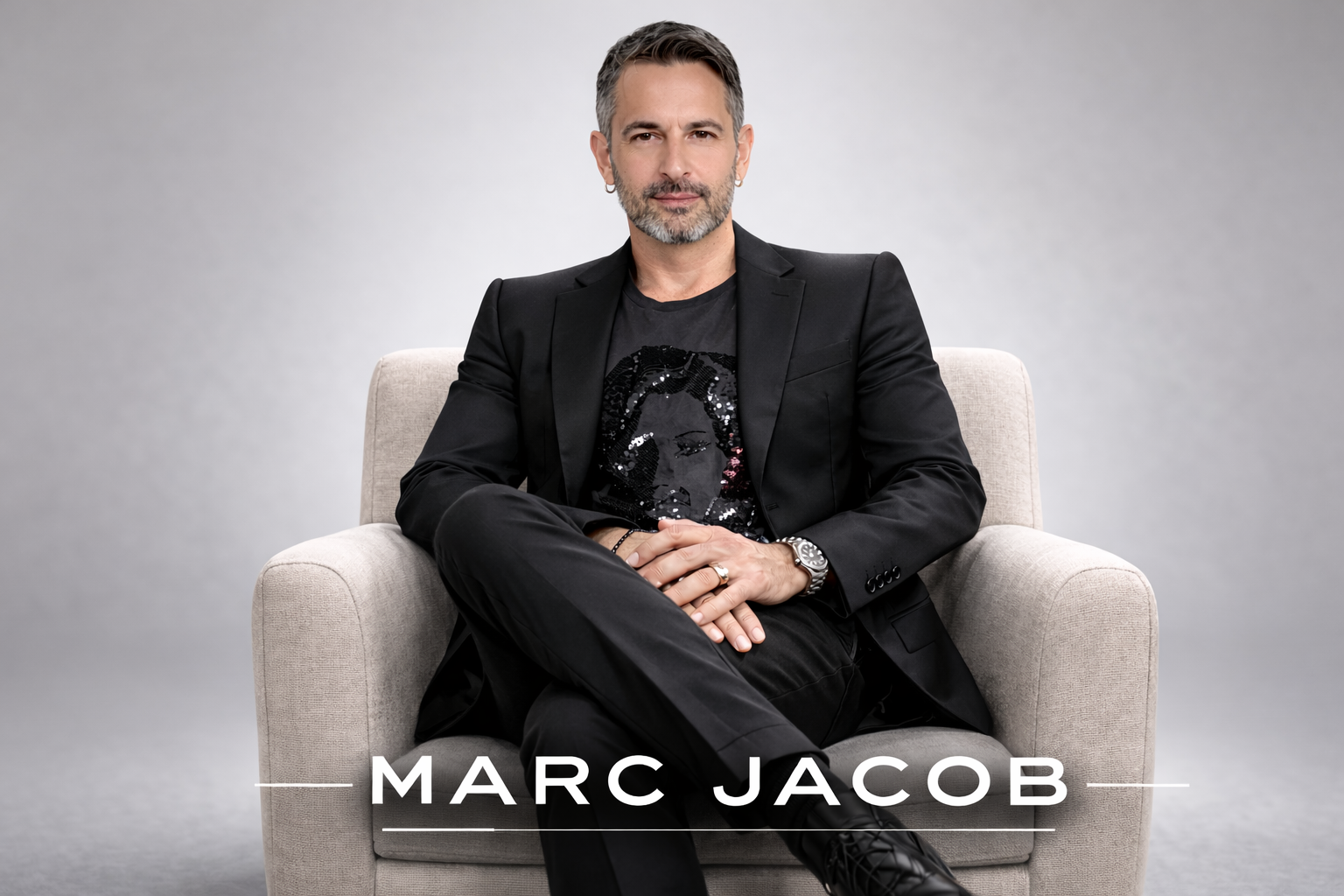
The Early Life of Marc Jacobs
The Marc Jacobs story begins not in a sleek presentation on the runway or in a famous fashion house, but in a young boy trying to navigate the busy streets of New York City. Born in 1963 in Manhattan, Jacobs had a childhood of creativity and turmoil. The death of his father had a profound effect on his life, creating a sense of sensitivity and introspection. In a constantly changing world, fashion was not just clothing but a means of protection and a way to express who one was. Jacobs’ earliest fashion influences came from his life with his grandmother on the Upper West Side of Manhattan. She loved beautiful things and was supportive of Jacobs’ endeavors, allowing him to experience the street life and underground culture that would influence his future work.
Jacobs was a young boy with a natural visual sense. He loved texture, shape, and the juxtaposition of different materials. These skills would propel him into formal education, first at the High School of Art and Design in New York City and then on to Parsons School of Design. At Parsons, Jacobs thrived. His student collections already displayed the duality that would define his career: a mastery of craftsmanship coupled with a playful rebellion against convention. These early explorations foreshadowed the creative audacity that would later make him one of the most influential designers of his generation.
Education and Early Influences
Jacobs’ experience at Parsons was not just an academic exercise but a full immersion in a community of mentors, peers, and industry experts who would influence his aesthetic. The program was highly competitive and encouraged a focus on the discipline of fashion design and the importance of storytelling through clothing. Jacobs was quickly recognized for his oversized hand-knit sweaters and graphic pieces that challenged the power dressing and extravagance of the early 1980s. Awards and accolades would follow the young designer who had a clear understanding of technical skill and a keen sense of aesthetics.
However, his formal education was only part of his foundation. Jacobs was inspired by the streets of New York City: the punk clubs, street wear of the young creatives who wore the clothing, and the edginess of the art gallery scene. Jacobs was also inspired by music: the rise of the underground music scene and alternative rock. Fashion was a reflection of life: messy, complicated, and emotionally charged. These early understandings of the importance of cultural context would become a defining element of Jacobs’ design philosophy and would help him connect the worlds of high fashion with the Zeitgeist of modern society.
Launching a Label

In 1986, American designer Marc Jacobs created his first collection under the Marc Jacobs label in New York, in collaboration with business strategist Robert Duffy. This was after Marc Jacobs had already received widespread acclaim for his graduation collection at the Parsons School of Design and had begun his career in the fashion industry. However, he realized that artistic success alone was not sufficient to guarantee a long-term fashion house. The creation of the Marc Jacobs label was, therefore, a creative and strategic move.
Marc Jacobs needed to be independent in the sense that he needed to have full control over the direction of the design, themes, and the identity of the brand, unlike working in a corporate environment where he would be restricted in his work. Robert Duffy, who had experience in business, saw the commercial potential in Marc Jacobs and assisted him in transforming his artistic vision into a business model. Their objective was to develop a brand that would focus on creative innovations, although they found it difficult to sustain themselves financially until they received massive corporate funding years later.
It was a brand that was born at a time when fashion in America was heavily inclined towards opulent power dressing and conservative glamour. Jacobs entered the fashion world at a time when he was intentionally challenging conservatism. By launching his own brand, Jacobs did not simply establish himself as a designer-for-hire, but rather as a creative force that was bent on redefining fashion in original ways.
Perry Ellis and Early Industry Recognition
Marc Jacobs’ breakthrough is closely associated with his period of work at Perry Ellis, during which he worked as a women’s wear designer from 1988. Perry Ellis was already known for its refined American sportswear with clean lines and commercial appeal. Yet, still in his mid-twenties, he was given the role of injecting new energy into the brand after the death of its founder. This gave him a position that was part of a corporate infrastructure that demanded commercial success and retail consistency.
Marc Jacobs used this period to see how far he could take innovation and disruption with an established brand. He introduced looser silhouettes, layering, and references to underground music scenes and youth cultures. His most famous moment came with the 1992 collection that reflected the grunge movement, which went against conventional ideals of glamour. While highly controversial and commercially divisive, it marked his commitment to believing that fashion must evolve with cultural change, rather than against it.
This period taught Jacobs how to manage the tension between innovation and market expectations. It clarified why independence mattered to him. The lessons learned at Perry Ellis directly informed the identity, risk tolerance, and narrative depth that later defined his own label.
The 1992 Grunge Collection
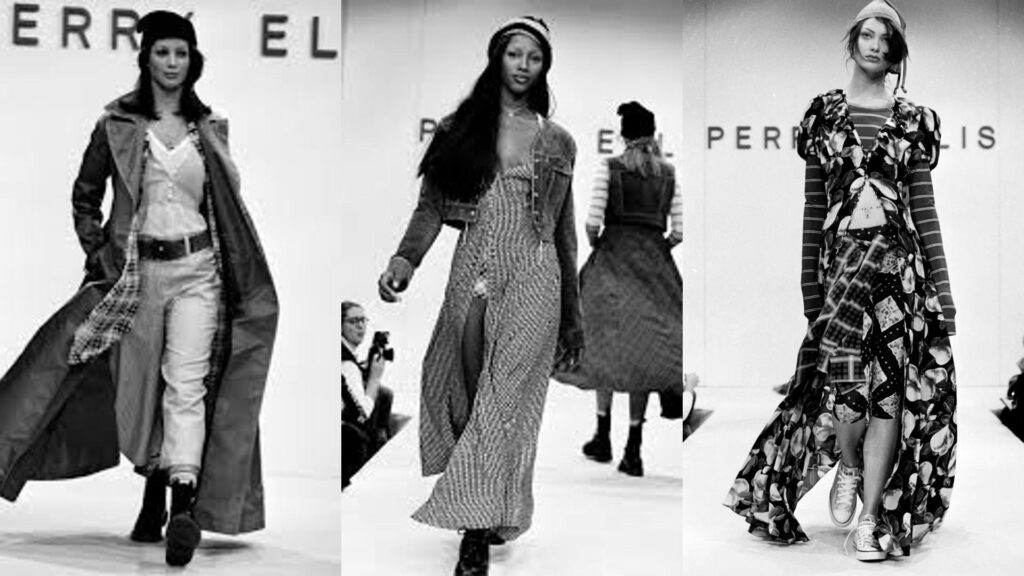
The turning point in Jacobs’ early career came in 1992 with his now-legendary “Grunge Collection.” Inspired by the Seattle music scene, thrift store aesthetics, and a very unglam sensibility, Jacobs took street fashion and elevated it. Rather than aping what he saw on the streets, Jacobs gave it a high fashion twist. His runway show featured models walking down the runway in disheveled clothing, accompanied by disheveled hairstyles and a raw, unadorned makeup look that challenged the conventional standards set by New York Fashion Week.
The reaction was immediate and polarizing. Fashion critics had mixed reviews. Some praised it as bold, while others criticized it as “unkempt” and “uncommercial.” But it only served to further solidify Jacobs’ status as a fashion designer unafraid to challenge conventional wisdom. The Grunge Collection challenged the status quo and made it clear that American fashion could be as interested in contemporary culture as any fashion house in Europe. But it also made it clear that Jacobs was a fashion designer unafraid to take risks.
Risk and Reputation
In 1992, Jacobs launched his now-famous grunge collection while in his position as Vice President of Women’s Design at Perry Ellis. This was no impulsive decision in favor of a new aesthetic direction. It was a calculated cultural statement. Jacobs took his inspiration from the emerging grunge music scene represented by bands like Nirvana. He adapted elements of this emerging fashion trend in his use of luxurious fabrics and craftsmanship.
Marc Jacobs launched this direction for a reason. He was fed up with the polished power dressing and conservative glamour that was still the fashion establishment in early 1990s America. He was of the opinion that clothing reflected the reality of society. He wanted his clothing to reflect the reality of youth disillusionment and rebellion against the establishment.
The cultural impact was immediate. The grunge collection was a wake-up call for new designers and stylists. It proved that fashion could engage with subculture and still be luxurious. It was a moment of clarity for Marc Jacobs. He realized his long-term vision was about combining unconventional sources of inspiration with technical excellence and allowing cultural commentary to play a part in his decision-making process.
Transition to Eponymous Success
After the controversy surrounding the 1992 grunge presentation for Perry Ellis, Jacobs entered a new era that was both more scrutinized and more opportune for him. While it ultimately led to his leaving the company, it also greatly increased his visibility in the international fashion world. By the mid-1990s, Jacobs focused this newfound visibility on reinvigorating his own eponymous line, which he and his business partner, Robert Duffy, officially founded as Marc Jacobs International in 1993.
It was a strategic move for Jacobs, as it coincided with a new fashion environment that emphasized designer-centric branding. After learning from his experience with Perry Ellis, Jacobs perfected his approach to fashion, striking a new balance between conceptualization and tailoring, as well as structure in production. Duffy handled licensing and retail, although it would take a major investment from LVMH in 1997 to resolve significant financial issues for the company. This division of labor allowed Jacobs to focus on his aesthetic evolution as a designer. They were able to position him to move from niche recognition to international influence throughout the late 1990s and early 2000s.
Founding the Eponymous Label
The journey of Marc Jacobs as an independent fashion brand begins in 1986 when the designer launched his brand in New York. At the time, Jacobs was in his early twenties and partnered with his lifelong friend and business brains Robert Duffy. The brand was a result of a collaboration between the visionary creativity of Jacobs and the business acumen of Duffy. The fashion industry was in a state of flux in the mid-1980s in America. The fashion landscape was dominated by conservative power dressing and opulent glamour. There was no space for a new voice in fashion that was both youthful and subcultural. The market was missing a brand of luxury that was both accessible and radical.
The brand of fashion created by Marc Jacobs was always about a certain philosophy of fashion that combined elements of high fashion and street sensibility. The fashion created in the early days of the brand was all about precise silhouettes, innovative fabric use, and a certain willingness to incorporate elements of different styles and cultures. Jacobs was not just selling clothing; he was presenting a lifestyle, an attitude, and a cultural lens through which fashion could be understood. The eponymous label became a platform for him to explore these ideas, though he initially struggled against the financial and operational constraints of his corporate backers.
Why the Eponymous Label? The Creative Impulse
Jacobs’ decision to start his own brand was heavily influenced by a mix of artistic expression and cultural ambitions. Having already established his own brand in 1986, his subsequent experience with the thrill and limitation of working with Perry Ellis merely reinforced his decision that he needed complete autonomy to express himself. He wanted to challenge the status quo that luxury fashion had to be exclusive or disconnected from culture. Jacobs realized that clothing could be used to make social commentary, to reflect subcultures, and to be an expression of individuality. His eponymous brand gave him the platform to execute this vision with precision and accuracy, while establishing brand identity that was synonymous with his own artistic expression.
Duffy’s involvement was crucial because it gave Jacobs the autonomy to completely focus on design by delegating other responsibilities. It was a move that helped maintain brand integrity from an artistic perspective, although they struggled to scale the brand because of severe financial constraints before receiving major corporate backing. Jacobs once noted that having a trusted partner in Duffy freed him from “the distractions of spreadsheets and investors,” enabling the label to focus on innovation, runway impact, and cultural resonance.
Key Milestones in the Early Years
Since its founding in 1986 by Jacobs and his business partner Robert Duffy, the Marc Jacobs brand has grown through deliberate creative and strategic developments. In the latter half of the 1980s and the early 1990s, Jacobs developed a reputation for his dramatic runway shows that married storytelling with technical skill. Post the investment from LVMH in 1997, the company set out on a deliberate expansion strategy in accessories. This was in response to the increased global appetite for accessories such as leather goods as a source of steady revenues.
A major turning point in the company’s history was in 1997 when Jacobs was appointed creative director of Louis Vuitton. Jacobs was instrumental in introducing ready-to-wear at the iconic luggage brand and also initiated the brand’s association with artists. This not only helped revamp the brand’s image but also increased the prestige of the Jacobs brand. In 2001, Jacobs launched the diffusion line Marc by Marc Jacobs to appeal to a younger demographic at a more affordable price point.
By 2015, the company consolidated its structure, closing the diffusion line to refocus on luxury positioning. Through the 2020s, Jacobs emphasized digital campaigns, archival revivals, and youth-driven casting, ensuring relevance through 2026 by balancing nostalgia, innovation, and direct cultural engagement.
Building a Global Brand: Strategy and Vision
The ascension of Marc Jacobs to the status of a global brand was also facilitated by its savvy understanding of the importance of marketing, celebrities, and retailing. From the beginning, Jacobs had fostered relationships with influential people in music, film, and the arts, so that the brand he created would have an impact beyond the runway.
The next step was the expansion of Marc Jacobs’ retail presence. Flagship stores in New York, Paris, and Tokyo provided Marc Jacobs an opportunity to create an immersive experience in which the aesthetic of the brand—edgy, luxurious, and culturally relevant—could be experienced in an unfiltered way. The design of the store, the curation of the visual merchandising, and even the curation of the staff were an extension of the designer’s storytelling sensibility, in which the experience of the store was an extension of the storytelling process, so that the retail spaces themselves became an extension of the Marc Jacobs’ brand, reinforcing the global identity of the brand and the loyal following of fashion-conscious consumers that it had acquired.
The Early Runway Disruptions
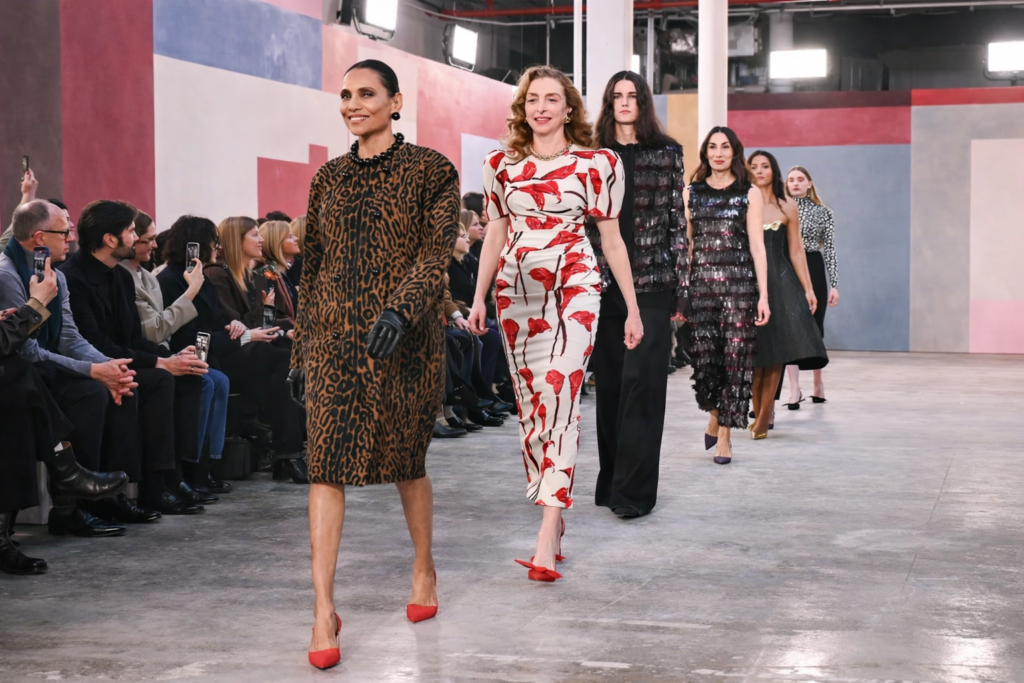
Marc Jacobs’ runway presentations soon became the events to attend, not just for the clothing but for the cultural statement he was making through his designs. By the late 1980s and early 1990s, Marc Jacobs’ collections had already started to subvert the traditional notion of beauty and fashion order. Take, for instance, the Spring/Summer 1989 collection, where the designs were playful, Western-inspired, and featured gingham and cowboy themes, a whimsical departure from the more formal power dressing that dominated American fashion at the time. Marc Jacobs wanted to subvert the traditional notion of clothing for both genders, but in a way that was also wearable.
It was also during this time that Marc Jacobs forged his alliance with celebrities, who would prove to be essential in promoting the Marc Jacobs brand in the coming years. Celebrities such as Winona Ryder, Sofia Coppola, and eventually Kim Gordon and Chloë Sevigny would wear his designs both on and off the red carpet, providing the brand with a natural but powerful cultural endorsement. Marc Jacobs understood that the power of the celebrity could work for the brand, to reinforce its voice in the world of youth, rebellion, and cutting-edge culture.
Louis Vuitton Era
One of the most important moments in Jacobs’ career, and for his brand, was when he was named creative director at Louis Vuitton in 1997. This was a surprise to the fashion world, where a young, edgy American designer would assume the role of creative director at one of the most historic luxury fashion brands in the world. Jacobs’ job was to make Louis Vuitton modern while also paying homage to its heritage, a tightrope that required careful balance between tradition and innovation.
Jacobs’ first ready-to-wear collection for Louis Vuitton was in 1998, and it featured his signature stark, minimalist aesthetic that focused on luxury materials rather than luxury branding. Jacobs would go on to feature graffiti designs, such as the famous Stephen Sprouse graffiti handbags in 2001, and collaborations with modern artists, such as the colorful monogram collection by Takashi Murakami in 2003. These collections were not only commercial successes, but they also sent an important cultural message that luxury could be fun, accessible, and associated with modern art. Jacobs’ work at Louis Vuitton also boosted his own brand, reinforcing his reputation for being a designer who could navigate the worlds of business, creativity, and culture.
Notable Marc Jacobs Collections and Themes
Throughout the 2000s, Marc Jacobs made it his goal to turn his brand into a collectible-driven global brand. After LVMH’s investment in 1997, Jacobs concentrated on developing rapid product growth during the early 2000s. In 2001, Marc by Marc Jacobs was introduced, which catered to young consumers looking for affordable luxury goods. It was during this year that small leather goods, logo jewelry, and seasonal accessories were introduced with high retail turnover.
In 2005, the Stam bag was introduced, named after model Jessica Stam. It quickly gained popularity with its quilted leather design and chain strap, becoming one of the most recognizable “It-bags” of the decade, especially during 2005-2008.
In 2006 and 2007, Jacobs introduced more collectible-driven items, including enamel bangles, charm bracelets, logo necklaces, and branded tech accessories like iPod cases. Footwear during 2004-2009 included platform heels that resembled glam rock from the 1970s and limited-edition sneakers that reflected streetwear’s impact on fashion.
The focus of the brand between 2008 and 2012 was to grow its contemporary diffusion range, known as Marc by Marc Jacobs, as well as its high-end accessories, including the Stam bag. These are clear indications of how Jacobs has worked to develop a collectible range of products.
Cultural Collaborations: Artists, Musicians, and Media
“Marc Jacobs has made collaboration a long-term strategy for his fashion brand since its founding in 1986.” In 1997, when Jacobs took over as creative director of Louis Vuitton, he launched what could be considered the most influential collaboration in the world of luxury fashion when he teamed up with Stephen Sprouse in 2001. This was followed by another highly successful collaboration with Takashi Murakami in 2003. The multi-colored Monogram collection was a reinterpretation of Louis Vuitton’s iconic logo and proved the potential of collaboration in creating a new paradigm of commercial success.
In the early 2000s, Jacobs worked in collaboration with photographer Juergen Teller. Teller’s unglamorized photography, especially after 1998, gave the brand of Marc Jacobs a new visual identity. In 2008, Jacobs collaborated with artist Richard Prince for Louis Vuitton.
Celebrity endorsements helped to ensure cross-industry relevance. Madonna worked with Louis Vuitton in 2009, and Lady Gaga appeared in the Fall 2016 campaign for Marc Jacobs. Contemporary music culture is linked with fashion through these celebrity endorsements. In 2020, Jacobs worked with Peanuts to create capsule collections with Snoopy prints.
Over four decades, these collaborations were carefully planned to ensure that they were culturally relevant. Marc Jacobs’ brand has been at the center of music, art, and pop culture since the 1990s and continues to be so until 2026.
Why These Collections Mattered
The works of Jacobs were significant not only for their beauty but also for their sociocultural relevance. They subverted conventional ideals of beauty, challenged the concept of luxury, and proved that fashion could be used as a catalyst for artistic dialogue. Every runway, accessory, and collaboration was an opportunity for storytelling, experimentation, and commentary on identity, culture, and society.
Through the fusion of whimsy and precision, rebellion and sophistication, and celebrity appeal and artistry, Jacobs cemented his brand as a global cultural phenomenon rather than simply a fashion house. His contributions to fashion continue to remind the industry that creativity is often the product of the intersection of authenticity, cultural understanding, and calculated risk.
Diffusion Lines and Market Reach
Marc Jacobs soon realized that luxury alone may not be enough to increase brand access. In 2001, Jacobs launched a diffusion line called Marc by Marc Jacobs. This line was designed to appeal to a younger demographic. Unlike the mainline brand, the diffusion line was more playful, accessible, and experimental. At the same time, the diffusion line did not lose the irreverence that defined the mainline brand.
The diffusion strategy was successful for Marc Jacobs, allowing the brand to expand internationally. It opened flagship stores in New York, Paris, Tokyo, and London. It also partnered with select department stores to increase brand access. The brand curated these stores according to its values, which were modern, slightly rebellious, and cultured.
Media Presence
However, Jacobs’ business savvy was not just limited to product offerings, as he also used the media and the power of celebrities to help maintain the momentum of his brand. By partnering with pop culture icons such as Lady Gaga, Sofia Coppola, and Chloë Sevigny, the Jacobs brand remained at the forefront of cultural conversations at all times. Strategic product placements in films, television, and music videos also ensured that Jacobs’ place at the crossroads of fashion, art, and media was not threatened.
The 2010s also saw the importance of the digital platform in the expansion of the Jacobs’ brand, and by engaging with global millennials through social media campaigns and e-commerce platforms, the brand set the stage for the 2020s, where the “Heaven” product offerings would utilize the power of the internet and the viral popularity of TikTok to engage the younger audience at a much deeper level than just the traditional store experience.
Legacy and Cultural Impact
Marc Jacobs’ legacy is not only about business but also culture. He has been redefining American fashion by integrating youth culture, art, and luxury, thereby developing a fashion language that is not only creative and bold but also rooted in individualism. His grunge movement, creative runway presentations, and partnerships with artists like Takashi Murakami and Stephen Sprouse have significantly changed the fashion discourse of the 21st century.
Even though Jacobs resigned from Louis Vuitton in 2013, his brand continued to flourish, proving that his impact was not only cultural but also institutionalized in the fabric of modern fashion.
Conclusion
Marc Jacobs is not just an individual; he is a cultural architect who has changed the way in which luxury is associated with youth identity and streetwear culture. From the time he appeared in the 1980s in New York to his appointment at Louis Vuitton in 1997, Marc Jacobs has always managed to blur the lines between high fashion and streetwear culture. From his grunge influence, oversized clothing, and slip dresses, Marc Jacobs has always been associated with the bridge between high fashion and streetwear culture. Marc Jacobs has not just followed the trend of streetwear; he has incorporated it into his brand, bringing together craftsmanship and rebellion. Marc Jacobs streetwear looks have managed to influence the younger generations, and the longevity of the Marc Jacobs brand is a result of the fact that when innovation meets cultural awareness, it is not just for the seasons but for the decades to come.
Frequently Asked Questions About Marc Jacobs
1. Who founded Marc Jacobs?
Marc Jacobs, born in 1963 in New York City, founded his eponymous brand in 1986, two years after graduating from Parsons School of Design.
2. When did Marc Jacobs become creative director of Louis Vuitton?
He joined Louis Vuitton in 1997 and remained until 2013, introducing ready-to-wear collections and groundbreaking artist collaborations.
3. What was the “Grunge Collection”?
The 1993 Grunge Collection for Perry Ellis featured intentionally disheveled styling, ripped flannels, slip dresses, and Doc Martens, challenging the era’s polished fashion norms.
4. What is Marc by Marc Jacobs?
The Marc by Marc Jacobs diffusion line launched in 2001 to offer younger consumers accessible luxury with playful, colorful, and experimental designs.
5. Which artists has Jacobs collaborated with?
Notable collaborations include Takashi Murakami, Stephen Sprouse, and Richard Prince, blending pop art and cultural references into fashion.
6. How has Marc Jacobs influenced street culture?
By merging runway fashion with youth subcultures, music, and art, Jacobs introduced subversive streetwear aesthetics into luxury markets worldwide.
7. What are his most iconic handbag designs?
Signature pieces include the Louis Vuitton Murakami Monogram and Graffiti collections, the Marc Jacobs Stam bag, and the modern retail sensation “The Tote Bag.”
8. Why is Marc Jacobs culturally significant?
He challenged industry norms, promoted inclusivity, and connected fashion to broader art and music movements, redefining American luxury.
9. Has the brand expanded globally?
Yes, with flagship stores in New York, Paris, and Tokyo, and select retail partnerships across Europe, Asia, and North America.
10. Is Marc Jacobs still designing today?
Yes, he continues to innovate through his eponymous label, focusing on ready-to-wear, accessories, collectible collaborations, and contemporary streetwear lines.
11. What inspired Jacobs’ early collections?
His early work drew from youth culture, music, film, and subcultures, blending technical tailoring with playful rebellion.
12. How did the Louis Vuitton tenure impact his brand?
Jacobs gained global recognition, learned to merge heritage luxury with innovation, and used the experience to elevate his eponymous label.
13. What is the brand’s approach to collaborations?
Jacobs partners with artists, photographers, musicians, and franchises to produce limited-edition handbags, apparel, and accessories that merge art and fashion.
14. Which celebrities have influenced Marc Jacobs campaigns?
Icons like Sofia Coppola, Lady Gaga, and top models have amplified the brand’s cultural reach.
15. How does Marc Jacobs balance luxury and accessibility?
Through sub-labels like Heaven, collectible accessories, streetwear-inspired pieces, and limited editions, the brand appeals to diverse markets without compromising creativity.
For collaborations, press, or inquiries, contact us at streeticonic1@gmail.com.

Origins: Yayoi Kusama’s Early Life and Beginnings
Yayoi Kusama was born on March 22, 1929, in Matsumoto, Nagano, Japan, to a family that owned a plant nursery and seed farm. When she was ten years old, she experienced vivid hallucinations involving repetitive patterns and dots, and she began sketching what she saw. These experiences became the foundation of her artistic vision and lifelong obsession with repetitive motifs.
As a child, Kusama began drawing scenes filled with dots and patterns that reflected her perceptions. Her mother discouraged her artistic interests and even destroyed some early works, creating emotional challenges that would shape Kusama’s psychological and creative worldview.
In 1948–1949, she attended the Kyoto City Specialist School of Arts but left formal education early. By 1957, her desire to pursue a career as an artist and escape family conflict led her to move to the United States, a decision that marked the beginning of her international art career.
Emerging Artist: Nets and New York Avant‑Garde
In New York during the late 1950s and 1960s, Kusama became known for her “infinity net” paintings—vast canvases covered in networks of tiny, repetitive marks that extended visually beyond the edges of the surface. These works explored the psychological boundaries of perception and infinity.
Her work quickly evolved, and she became part of the avant‑garde art scene, exhibiting alongside artists such as Donald Judd, Claes Oldenburg, and Andy Warhol. She embraced Pop art, Minimalism, and performance art, often staging radical happenings that challenged social norms, gender roles, and artistic boundaries.
In the early 1960s, Kusama’s art included sculpture and installation, notable among them Accumulation No. 1 (1962)—an armchair covered with soft phallic forms—and Infinity Mirror Room—Phalli’s Field (1965), a mirrored installation filled with dotted objects that created endless reflections.
Artistic Philosophy: Obsession, Repetition, and Infinity
Kusama’s art centers on themes of repetition, self‑obliteration, and infinity—ideas rooted in the hallucinations she experienced as a child. She used repeated dots, nets, and mirrored surfaces to depict endless space and psychological immersion, linking personal experience with universal concepts of eternity and existence.
Kusama herself described her artistic drive as an “obsessive artist,” creating work that dissolves boundaries between self and environment. Her dots and nets became symbolic; they obliterate form while creating visual fields that suggest infinity and interconnectedness.
Her early performances in New York included antiwar and anti-establishment happenings, sometimes involving naked participants covered in dots. These events questioned identity, conformity, and artistic boundaries, situating Kusama as a provocative figure in the art world during a time of cultural upheaval.
Return to Japan and Continued Creativity
In 1973, Kusama returned to Japan and, from 1977 onward, chose to live in a psychiatric hospital near her studio in Tokyo while continuing to produce art daily. Her decision reflected a desire for stability and focus on creation rather than confinement.
During this period, she wrote surreal fiction and poetry while maintaining a rigorous art practice. Kusama’s writing, including novels such as The Hustlers Grotto of Christopher Street (1978) and Between Heaven and Earth (1988), mirrored the intense psychological themes of her visual art.
By the late 1980s and early 1990s, Kusama returned to global art stages with major exhibitions in New York and Europe. In 1993, she represented Japan at the Venice Biennale, showcasing works such as Mirror Room (Pumpkin)—an installation combining her signature dots with mirrored environments.
Global Recognition and Immersive Installations
From the late 1990s onward, Kusama’s international stature grew, with major retrospectives at institutions such as the Los Angeles County Museum of Art and the Museum of Modern Art (MoMA) in New York. These exhibitions celebrated her influence across decades and mediums.
Her Infinity Mirror Rooms—immersive installations lined with mirrors, lights, and repeated objects—became iconic in contemporary art. Works like Infinity Mirrored Room – Filled with the Brilliance of Life (2011) evolved from her early obsessions with repetition to fully immersive cosmic environments. Kusama also explored fashion and collaborations beyond the gallery. In 1968, she launched Kusama Fashion Company Ltd., creating polka-dotted garments sold in Bloomingdale’s, demonstrating her early fusion of art and design. In 1969, she opened her own boutique, and later collaborations included limited editions with Louis Vuitton, bringing her visual language into the world of fashion.
Major Works: Infinity Mirror Rooms, Narcissus Garden, and Pumpkin Sculptures
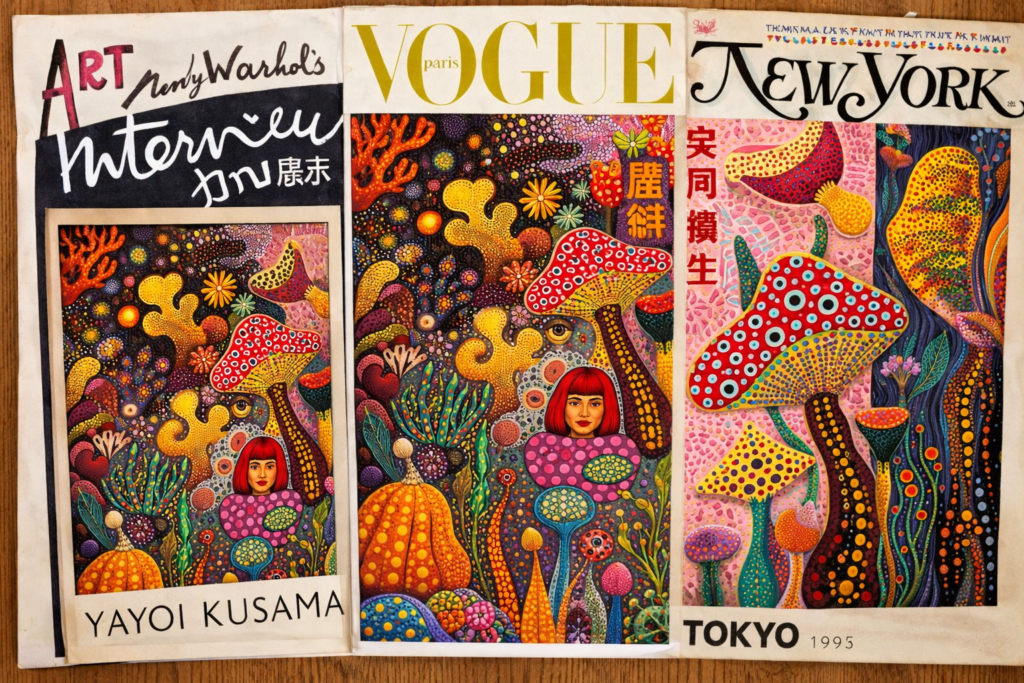
Yayoi Kusama’s Infinity Mirror Rooms are perhaps her most recognizable contributions to contemporary art. First conceived in the 1960s, these installations use mirrors, lights, and repetitive objects to create the illusion of infinite space. The visitor becomes part of the artwork, experiencing immersion and disorientation simultaneously. Works like Infinity Mirror Room – Phalli’s Field (1965) and The Souls of Millions of Light Years Away (2013) transform perception, blurring the boundaries between self and environment. (yayoikusamamuseum.jp)
Another hallmark of Kusama’s oeuvre is the Pumpkin series, inspired by her childhood memories of pumpkins at her family farm. These sculptures, often painted in vivid polka dots, became iconic symbols of her work. Installations like the giant outdoor pumpkin at Naoshima Island, Japan, merge natural form with her signature patterns, connecting folk imagery to avant-garde abstraction. Narcissus Garden (1966) challenged conventional art contexts and commercialism. Originally installed at the Venice Biennale, it consisted of hundreds of mirrored spheres floated on the water and placed on the lawn, reflecting both the environment and viewers. Kusama sold the spheres for two dollars each outside the pavilion, subverting the traditional artist-gallery relationship and questioning the commodification of art.
Yayoi Kusama Brand Evolution Timeline
| Year | Milestone / Event |
| 1929 | Born in Matsumoto, Japan. Early obsession with repetition, polka dots, and infinity becomes the foundation of a visual language later adopted by streetwear culture. |
| 1957 | Moves to New York, immersing herself in avant-garde and counterculture scenes—paralleling early streetwear’s rebellion and anti-establishment mindset. |
| 1965 | Creates the first Infinity Mirror Room, introducing immersive environments that later inspire experiential retail spaces and fashion installations. |
| 1966 | “Narcissus Garden” critiques consumerism—an idea deeply connected to modern streetwear drops, hype culture, and resale markets. |
| 1967 | Kusama’s “Happenings” (performance art) blur art, fashion, and protest—early examples of wearable art influencing future streetwear expression. |
| 1973 | Returns to Japan, continuing to create art rooted in identity and mental health—themes widely explored in contemporary streetwear storytelling. |
| 1993 | Represents Japan at the Venice Biennale, marking her global resurgence and influencing a new generation of artists and designers. |
| 2000 | Infinity aesthetics (dots, repetition, immersive visuals) begin influencing fashion graphics, prints, and conceptual streetwear design. |
| 2012 | Major collaboration with Louis Vuitton introduces Kusama’s polka dots to global fashion, bridging luxury and streetwear culture. |
| 2017 | Kusama Museum opens in Tokyo, becoming a cultural hotspot and visual inspiration for creatives, designers, and streetwear brands. |
| 2018 | Exhibitions at institutions like Tate Modern amplify her influence across visual culture, fashion editorials, and streetwear campaigns. |
| 2020 | Digital exhibitions inspire virtual fashion and online drops, aligning with streetwear’s shift toward digital culture and global accessibility. |
| 2021 | Infinity Mirror Rooms drive “Instagram culture,” influencing streetwear marketing, visuals, and hype-driven brand storytelling. |
| 2022 | Second collaboration with Louis Vuitton merges art, luxury, and streetwear aesthetics—seen in hoodies, sneakers, and accessories. |
| 2023 | Kusama’s patterns dominate fashion capsules, inspiring streetwear brands to adopt bold repetition, color blocking, and immersive branding. |
| 2024 | Continued influence on experimental streetwear—AI visuals, immersive pop-ups, and conceptual retail spaces echo Kusama’s infinity philosophy. |
| 2025 | Kusama’s legacy defines the intersection of art and streetwear—her polka dots, infinity concepts, and immersive vision continue shaping fashion, hype culture, and creative direction globally. |
Yayoi Kusama Streetwear Influence
Yayoi Kusama’s impact on streetwear comes from her lifelong mission to merge art with everyday life, a vision she began exploring as early as the 1960s when she launched experimental fashion pieces in New York to challenge social norms and consumer culture. Decades later, this philosophy naturally translated into modern streetwear through collaborations with brands like Louis Vuitton and X-Girl.
In 2012, creative director Marc Jacobs invited Kusama to reinterpret iconic products using her signature polka dots and infinity patterns, followed by a larger 2023 collection that included sneakers, ready-to-wear shirts, and accessories designed as wearable art. These sneakers often featured bold color blocking and repetitive dot motifs, transforming functional footwear into collectible design objects, while graphic shirts showcased her immersive artwork imagery, bridging gallery culture with street fashion.
Collectibles such as limited-edition bags, accessories, and special packaging became highly sought after because they carried both artistic value and brand prestige. Kusama’s streetwear relevance exists because her themes of repetition, identity, and self-expression align perfectly with youth culture and hype-driven fashion. By turning clothing into art experiences, she influenced how collaborations function today, where scarcity, visual impact, and storytelling create cultural demand beyond traditional fashion.
Yayoi Kusama Limited Drops, Graphic Shirts, Sneakers, and Collector Culture
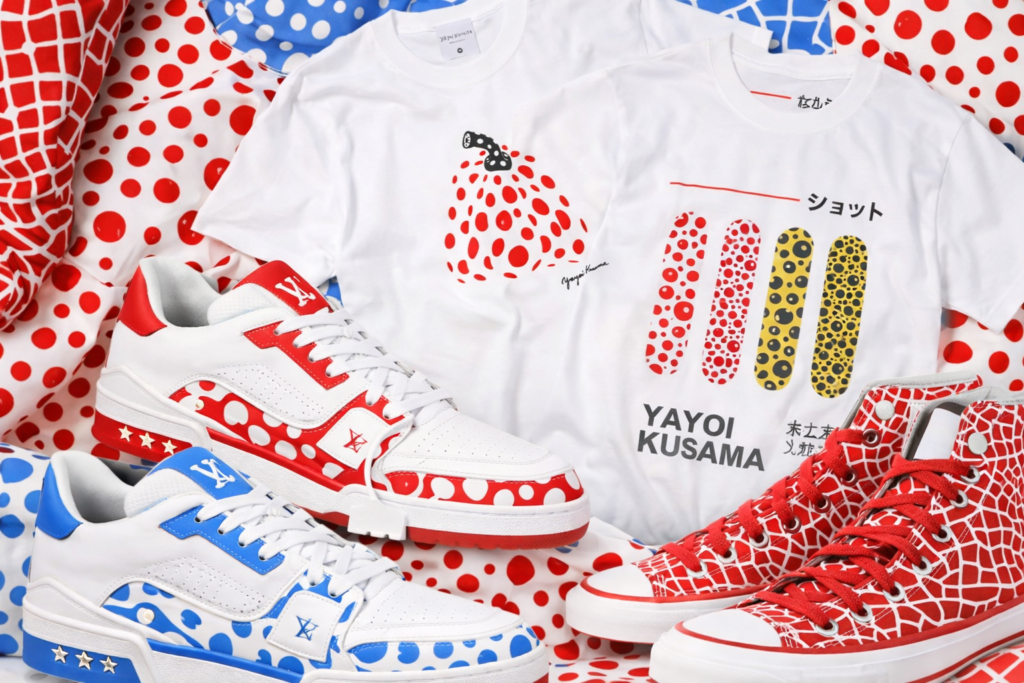
A key reason Yayoi Kusama resonates with streetwear audiences is the way her art adapts to modern drop culture and collectible fashion ecosystems. Rather than simply printing artwork onto garments, brands have used her motifs to create immersive product stories that extend across shirts, sneakers, and accessories released in timed launches. Collaborations with companies like Uniqlo introduced affordable graphic T-shirts that allowed younger consumers to access museum-level art through everyday clothing, while premium releases from luxury houses targeted collectors seeking rarity and status.
Sneakers inspired by her work often incorporate high contrast color palettes, layered textures, and sculptural details that mirror her installations, turning footwear into statement pieces rather than basic merchandise. Shirts function as portable canvases that emphasize individuality, which aligns with streetwear’s core values of identity and self expression.
Collectibles such as bags, small leather goods, and special packaging gain secondary market demand because they sit at the intersection of art ownership and fashion hype. Brands pursue Kusama collaborations not only for aesthetics but because her global recognition bridges generations, cultures, and price tiers, allowing streetwear to connect art institutions, luxury consumers, and youth communities within a single cultural moment.
Cultural Influence, Exhibitions, and Legacy
Kusama’s influence spans multiple disciplines—visual art, literature, fashion, and popular culture. Her avant-garde performances in the 1960s influenced feminist and conceptual art movements, inspiring artists like Marina Abramović and Carolee Schneemann. Her obsessive repetition and immersive environments anticipated aspects of installation art and experiential exhibitions that dominate contemporary museum practice.
Her work has been featured in retrospectives at institutions such as the Tate Modern (London), Whitney Museum of American Art (New York), and Pompidou Centre (Paris). These exhibitions not only celebrate her longevity but also showcase her evolving use of materials and psychological depth, establishing her as a bridge between mid-20th-century avant-garde and 21st-century immersive art.
Kusama’s writings, including her poetry and novels, also contribute to her cultural legacy. Her autobiographical accounts, such as Infinity Net (2002), provide insight into her mental health struggles, her hallucinations, and the role of obsession in her creative process. By merging life experience and art, Kusama has influenced generations of artists and writers worldwide.
Awards, Honors, and Institutional Impact
Yayoi Kusama has received global recognition for her contributions to art. In 2006, she was awarded the Premium Imperiale by the Japan Art Association, often considered the Nobel Prize of the arts. She has also received the Order of Culture from the Japanese government and honorary doctorates from prestigious institutions.
Museums worldwide have acquired Kusama’s works, creating dedicated spaces for her installations. The Yayoi Kusama Museum in Tokyo, opened in 2017, provides structured access to her work through rotating exhibitions, highlighting her global influence. Her practice continues to inspire museum curatorial approaches, particularly in designing immersive, visitor centered exhibitions.
Her achievements are notable not only for artistic innovation but also for mental health advocacy, as she has openly discussed her psychiatric treatment and how art functions as therapy. This has created a unique intersection between art, wellness, and public discourse, emphasizing the societal impact of her work.
Modern Popularity and Social Media Phenomenon
In recent years, Kusama’s popularity has surged among younger audiences through social media platforms, particularly Instagram. Her visually striking installations, especially the mirrored Infinity Rooms, are frequently shared online, transforming her work into global photo and cultural experiences. The immersive nature of her exhibitions encourages engagement and participation, contributing to her status as a pop-culture icon.
Her collaborations with fashion brands such as Louis Vuitton and participation in large scale public art projects, including enormous outdoor pumpkin sculptures, bridge the gap between fine art and commercial culture. These partnerships further cement Kusama’s influence across contemporary design, fashion, and lifestyle markets, expanding her reach beyond traditional gallery spaces.
Kusama continued to produce work well into her 90s, maintaining a global presence through exhibitions, collaborations, and publications. Her art remains a vivid exploration of psychedelic perception, obsessive repetition, and human connection, ensuring that her legacy will influence generations to come.
Conclusion
Yayoi Kusama’s work transcends traditional art boundaries, merging painting, sculpture, and immersive installations into a global phenomenon. Her signature polka dots, infinity rooms, and surreal motifs have influenced not only contemporary art but also streetwear and fashion collaborations, inspiring designers and brands worldwide. Kusama’s fearless exploration of mental health, repetition, and obsession resonates across generations, making her a cultural icon. Her impact is seen in galleries, museums, and urban spaces, blending creativity with accessibility. From high fashion to streetwear collaborations, Kusama proves that art is limitless, immersive, and transformative, leaving an enduring mark on culture and style.
Frequently Asked Questions (FAQs)
1. Who is Yayoi Kusama?
Yayoi Kusama is a Japanese contemporary artist known for her polka dot patterns, infinity rooms, sculptures, and immersive installations.
2. What are Infinity Mirror Rooms?
Infinity Mirror Rooms are immersive installations by Kusama using mirrors and lights to create the illusion of endless space.
3. How has Kusama influenced streetwear?
Her bold patterns and polka dots have inspired fashion designers and streetwear brands, appearing on clothing, sneakers, and accessories worldwide.
4. Where can I see Yayoi Kusama’s work?
Her work is displayed in major museums globally, including the Yayoi Kusama Museum (Tokyo), Tate Modern (London), and Guggenheim (New York).
5. What is Kusama’s signature motif?
Polka dots, nets, and pumpkins are her iconic motifs, representing infinity, obsession, and mental landscapes.
6. Has Kusama collaborated with fashion brands?
Yes, she has collaborated with Louis Vuitton, Supreme, and other streetwear and luxury brands, merging art with fashion.
7. What inspired Kusama’s art style?
Her experiences with hallucinations, mental health, and obsession with repetition shaped her unique visual language.
8. When did Kusama start her art career?
She began formally studying art in the 1940s and gained international recognition in the 1960s after moving to New York.
9. Are Kusama’s works collectible?
Yes, her paintings, sculptures, and limited-edition fashion collaborations are highly collectible and valued globally.
10. What is “Narcissus Garden”?
A 1966 installation of mirrored spheres that challenged commercialization and interaction in art, first shown at the Venice Biennale.
11. How does Kusama address mental health in her art?
Through repetition, immersive spaces, and personal narratives, Kusama channels her experiences into visually therapeutic and expressive works.
12. Are there Kusama exhibitions for children?
Yes, her colorful and interactive installations are often family friendly and engaging for young audiences.
13. Does Kusama still create art today?
Yes, she continues to produce paintings, sculptures, and installations daily at her Tokyo studio.
14. How do I visit the Yayoi Kusama Museum?
Located in Tokyo, advance tickets are recommended due to timed entries and high demand.
15. Can Kusama’s art inspire DIY streetwear?
Absolutely! Her polka dot patterns and bold designs are popular inspirations for custom streetwear, clothing, and accessories.
For collaborations, press, or inquiries, contact us at streeticonic1@gmail.com.
Samsung – Origins and Early History
Samsung began long before it became a global tech leader. The company’s roots trace back to March 1, 1938, when Lee Byung‑Chull founded a trading business in Taegu (now Daegu), Korea. It was called Samsung Sanghoe and sold dried fish, noodles, and groceries while exporting goods to China and Manchuria. The name Samsung comes from the Korean for “three stars,” symbolizing something big, numerous, and powerful (the “three”) and everlasting or eternal (the “stars”).
Korea was still under Japanese rule when Samsung started. The business began with just forty employees and humble goals. Its early focus was not electronics — it was trade and food export. Lee’s ambition, however, always aimed at growth and diversification.
In 1947, Samsung moved its headquarters to Seoul, then expanded into sugar refining with Cheil Jedang in Busan after the Korean War. The company soon ventured into textiles, founding Cheil Mojik, which built Korea’s largest woollen mill in Daegu.
During the 1950s and 1960s, Samsung diversified into insurance, securities, retail, and industrial projects, including fertilizer and chemical businesses. By then, it had become a major player in Korea’s post‑war economic growth.
Samsung Steps into Electronics
Samsung made a defining shift in 1969 when it formally founded Samsung Electronics in Suwon, South Korea, marking its entry into consumer electronics. Its first products were black‑and‑white televisions, a bold move that set the company on a path to technological innovation.
Samsung sent trainees overseas to Japanese companies like Sanyo and Toshiba to learn electronics manufacturing, including tubes, transformers, and display technology. This early training helped build Samsung’s internal technical capability.
In the 1970s, the electronics division expanded rapidly. Samsung produced not only TVs but also home appliances such as refrigerators, washing machines, and air conditioners. In 1974, the SR-201XD refrigerator was launched, marking a milestone as Korea’s first direct-cooling refrigerator.
The same decade saw Samsung acquire Korea Semiconductor, which laid the foundation for its semiconductor business. By the late 1970s, the company had produced over 4 million black-and-white televisions, the most in the world, and was rapidly building global export capacity.
Growth into a Technology and Semiconductor Powerhouse
In the 1980s and 1990s, Samsung deepened its technology focus. It became one of the world’s leading manufacturers of memory semiconductors. Samsung’s DRAM development milestones included producing the first 64MB DRAM in 1992, followed by the world’s first 256Mb DRAM in 1994 and the first 1Gb DRAM in 1996 — breakthrough products that fueled global demand.
The company also pioneered high‑capacity flash storage. In 2004, Samsung developed the world’s first 8Gb NAND flash memory chip, later becoming a key supplier of chips to major tech firms, including Apple.
Meanwhile, consumer electronics continued to diversify. In 2010, Samsung expanded its Galaxy mobile device lineup, introducing Galaxy Tab tablets and subsequently launching Galaxy Gear smartwatches in 2013 as part of its push into connected devices.
Samsung’s willingness to innovate extended to foldable technology. In 2019, the company launched the first Galaxy Fold, blending smartphone and tablet designs in a pioneering format.
Samsung’s Evolution into a Global Tech Leader

By the 1990s and 2000s, Samsung had shifted from a national player to a global technology leader. It became the top seller of televisions worldwide, driven by innovations in LCD and display technology.
Leadership transitions also shaped Samsung’s direction. After founder Lee Byung‑Chull’s death in 1987, his son Lee Kun‑Hee transformed the company’s strategy from low‑end manufacturing to high‑quality innovation. Samsung moved aggressively into premium electronics, including mobile devices, semiconductors, and cutting‑edge displays.
In 2020, after Lee Kun‑Hee’s death, leadership passed to his son Lee Jae‑Yong, formally appointed chairman of Samsung Electronics in 2022. Under his guidance, the company launched massive investment plans totaling hundreds of billions of dollars in AI, next‑generation semiconductors, and advanced technologies to secure future growth.
Samsung continues evolving its product portfolio and global strategy. Its latest innovations include the world’s largest micro RGB display (130‑inch) unveiled at CES 2026, showing Samsung is still at the forefront of display technology.
Samsung’s Product Ecosystem and Innovation
Samsung is not just a company; it is a technology ecosystem. Its product lines span mobile devices, televisions, home appliances, semiconductors, and display technology, creating a cohesive network that touches billions of lives worldwide. This ecosystem strategy allows Samsung to integrate products, services, and innovations seamlessly, making its devices work together efficiently.
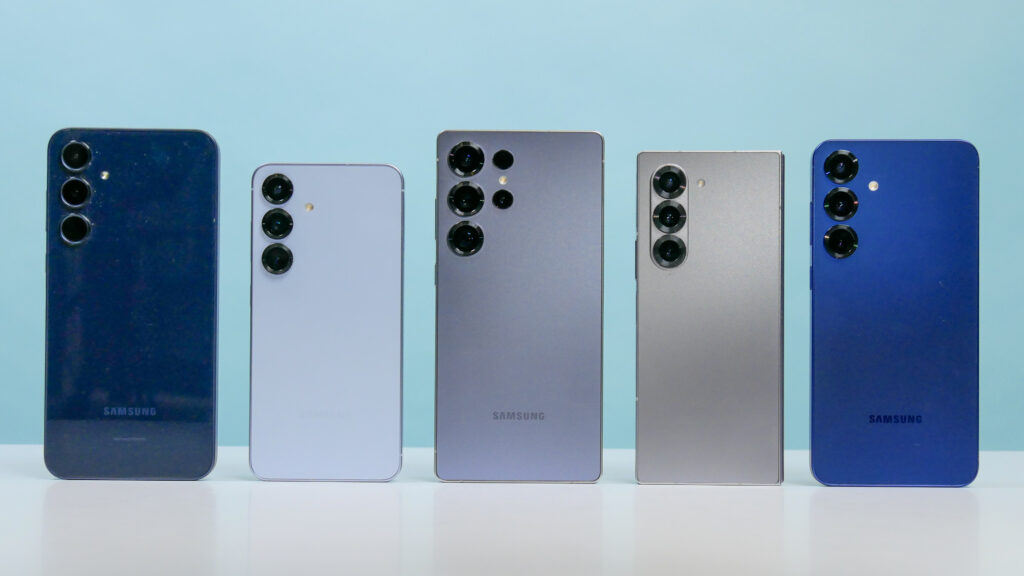
The Galaxy brand exemplifies this ecosystem. Starting in 2009 with the original Samsung Galaxy (GT-I7500), Samsung redefined the mobile market. The Galaxy S series, introduced in 2010, competed head-to-head with Apple’s iPhone. The company focused on high-resolution displays, durable batteries, fast processors, and sleek design, ensuring global appeal. Today, Samsung sells hundreds of millions of Galaxy devices annually, including smartphones, tablets, smartwatches, and wireless earbuds.
Samsung’s innovation in foldable technology demonstrates its commitment to pushing boundaries. In 2019, it launched the first Galaxy Fold, a device that combines smartphone portability with tablet functionality. Later iterations, rebranded under the Galaxy Z series (such as the Z Fold2 and Z Flip), introduced new hardware mechanisms and ultra-thin glass technology, redefining mobile form factors. These devices showcase Samsung’s research-intensive approach, with billions invested in R&D annually.
Consumer Electronics Leadership
Samsung’s consumer electronics segment is equally influential. The company leads in televisions, refrigerators, washing machines, and air conditioners, often integrating smart home technology. Samsung’s QLED TVs, introduced in 2017, use quantum-dot technology to achieve brilliant color volume, industry-leading brightness, and improved energy efficiency. Samsung has also been a pioneer in 8K TVs, smart home integration via SmartThings, and AI-driven enhancements for visual and audio experiences.
Home appliances are not just functional; they are connected devices. Samsung’s refrigerators, for instance, can now track grocery inventory, suggest recipes, and sync with smartphones. Washing machines can be remotely controlled, and smart ovens adjust cooking settings automatically. This IoT integration exemplifies Samsung’s forward-thinking strategy: products are no longer standalone; they are components of a larger ecosystem. (news.samsung.com)
Semiconductors and Advanced Technology
Perhaps the crown jewel of Samsung’s business is semiconductors. Samsung is the world’s largest manufacturer of DRAM and NAND flash memory, while also being a major producer of high-bandwidth memory. These chips power not only Samsung devices but also Apple iPhones, PCs, servers, and cloud infrastructure worldwide.
In addition to memory, Samsung is a leader in system semiconductors, including processors, sensors, and mobile application processors. While its Exynos chips are used in various mobile devices, Samsung heavily utilizes Qualcomm’s Snapdragon series for its flagship smartphones. The company also invests heavily in next-generation AI chips, automotive chips, and advanced logic semiconductors, ensuring it remains at the cutting edge of technology.
Samsung’s semiconductor division contributes a large portion of its revenue, allowing the company to reinvest in innovation. By 2025, Samsung plans to lead in 3nm chip production, positioning itself for AI, 5G, and high-performance computing markets.
Samsung Streetwear, Sneakers, and Apparel Culture
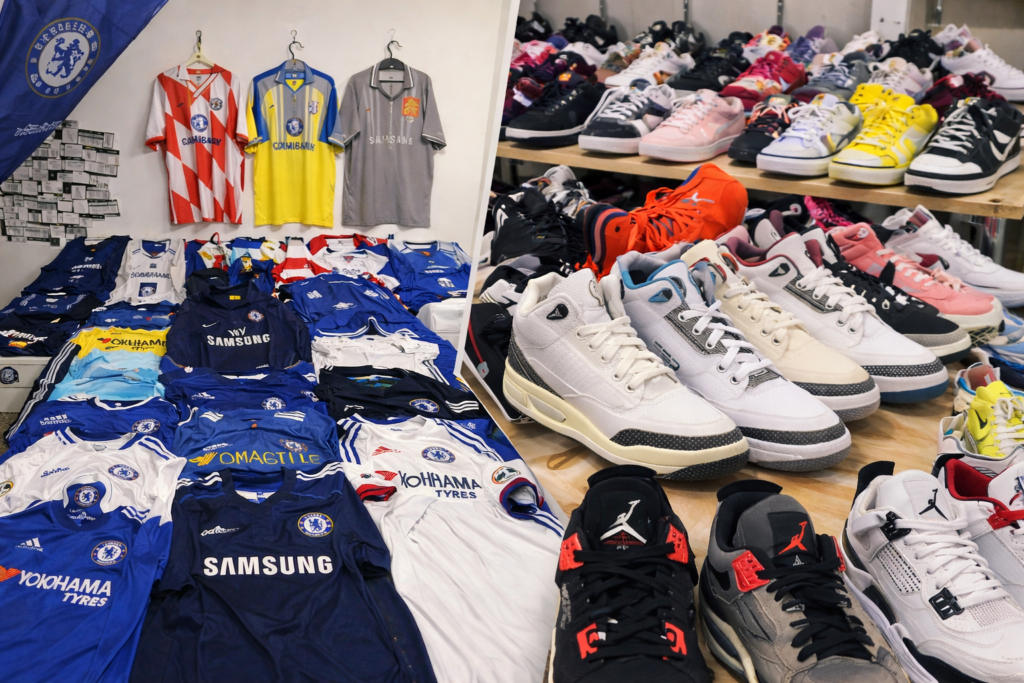
Samsung’s connection to streetwear culture has expanded beyond technology into fashion-inspired merchandise, including sneakers, shirts, and branded lifestyle apparel. While the company is not a traditional fashion label, its collaborations with sports organizations, gaming communities, and limited promotional campaigns have produced collectible clothing that resonates with sneaker and streetwear audiences. Branded T-shirts, hoodies, and jerseys featuring Samsung logos or campaign graphics often appear during product launches, esports tournaments, and sponsorship activations, turning corporate branding into wearable culture.
Sneaker culture intersects with Samsung primarily through partnerships, influencer marketing, and tech-focused collaborations. Limited-edition sneakers inspired by smartphone colors, futuristic materials, or foldable technology themes have been released in collaboration with designers and promotional campaigns. These items appeal to collectors who value exclusivity, innovation, and cross-industry creativity. The sleek design language of Samsung devices, especially Galaxy smartphones and wearables, naturally complements sneaker aesthetics, reinforcing the brand’s presence in lifestyle fashion conversations.
Streetwear thrives on identity and community, and Samsung taps into this by connecting technology with personal style. Fans often pair Samsung devices with sneakers and branded apparel as part of a coordinated look, turning tech into a fashion statement. This fusion of electronics, footwear, and clothing positions Samsung not only as a technology leader but also as a culturally relevant lifestyle brand.
Global Influence and Market Leadership
Samsung’s influence goes beyond products. It is a global cultural and technological brand, often shaping consumer expectations and market trends. Samsung smartphones dominate markets in Europe, Asia, and Latin America, while its TVs are top sellers in North America and its home appliances lead in several major markets across the Middle East.
Samsung’s approach blends aggressive marketing, innovation, and strategic partnerships. The company sponsors major events like the Olympics, collaborates with tech firms like Google and Microsoft, and invests in startup ecosystems and AI research. These strategies not only expand Samsung’s market share but also position it as a thought leader in consumer electronics and digital innovation.
Sustainability and Corporate Responsibility
Samsung increasingly emphasizes sustainability. The company has committed to reducing carbon emissions across its factories, increasing recycled materials in devices, and advancing energy-efficient technologies. Samsung also focuses on digital inclusion, prioritizing accessibility features in its software and providing global education programs to empower youth in underserved communities. For example, its Galaxy Upcycling program transforms old smartphones into IoT devices, extending their lifecycle and reducing e-waste. Sustainability is now a core component of Samsung’s global strategy, aligning with environmental, social, and governance (ESG) priorities.
Legal and Market Challenges
No company grows without challenges. Samsung has faced intense competition, intellectual property disputes, and regulatory scrutiny. The most famous case was the Apple vs. Samsung patent dispute in the 2010s, which led to significant multi-million-dollar settlements after years of litigation. Moreover, Samsung competes with Apple, Huawei, and Xiaomi in smartphones, and with LG in TVs and home appliances. Its ability to adapt quickly, invest in R&D, and maintain brand loyalty has helped it survive these challenges and maintain a global leadership position.
AI and Smart Technology
Artificial Intelligence is central to Samsung’s innovation strategy. Its comprehensive AI framework, including Galaxy AI and integrated Google Gemini models, powers voice assistants, smart home integration, and device optimization. Samsung is also developing AI chips that enable faster processing for edge computing, IoT devices, and autonomous systems. By embedding AI into mobile devices, appliances, TVs, and industrial solutions, Samsung seeks to create a truly intelligent ecosystem, where devices anticipate user needs and optimize energy consumption, convenience, and security.
In addition, Samsung’s AI research supports visual recognition, natural language processing, and predictive analytics. These technologies enhance user experiences in smart TVs, robotics, and connected cars, positioning Samsung at the forefront of consumer-facing AI applications.
6G Connectivity and Next-Gen Networks
Samsung is a pioneer in 6G research, aiming to go beyond the current 5G standards. While 5G has revolutionized mobile data, 6G promises ultra-low latency, massive IoT integration, and AI-enabled network optimization. Samsung’s 6G initiatives focus on holographic communication, extended reality (XR), and industrial automation. By leading early 6G development, Samsung ensures its devices, networks, and semiconductors remain future-proof in a hyper-connected world.
Robotics and Automation
Robotics represents another frontier for Samsung. The company has introduced home assistant robots, industrial automation solutions, and advanced AI-driven machines. Samsung’s robotics initiatives aim to simplify domestic chores, enhance industrial productivity, and improve healthcare outcomes. For example, robots equipped with AI can assist in elderly care, deliver goods in warehouses, or even perform precision tasks in manufacturing plants. Samsung’s investment in robotic research demonstrates its focus on creating devices that go beyond traditional electronics, moving towards intelligent systems capable of autonomous decision-making.
Foldable Technology and the Mobile Roadmap
Samsung continues to innovate with foldable devices, making this technology more durable, affordable, and practical. The latest Galaxy Z Fold and Z Flip models feature improved hinge mechanisms, ultra-thin flexible glass, and longer-lasting batteries. Samsung’s roadmap hints at larger foldable tablets, dual-fold designs, and hybrid devices that merge smartphones, tablets, and laptops into a single portable form factor. Foldables are more than novelty devices—they represent Samsung’s vision for modular, adaptive hardware, capable of responding to user lifestyles and creating new experiences in mobile computing and entertainment.
Global Strategy and Market Expansion
Samsung’s global strategy balances innovation, marketing, and localized production. It maintains regional R&D centers in countries like South Korea, the U.S., and India to tailor products to local markets. Strategic partnerships with telecom providers, app developers, and tech startups further expand its ecosystem. The company’s supply chain resilience helps it mitigate global disruptions, though it remains vulnerable to geopolitical unrest and trade restrictions. Investments in domestic chip manufacturing and energy-efficient factories ensure long-term sustainability and competitiveness. By focusing on innovation, affordability, and ecosystem integration, Samsung secures leadership across diverse global markets.
Cultural and Social Impact
Samsung is more than a tech company—it shapes digital culture, consumer expectations, and global innovation trends. From sponsoring the Olympics to creating cutting-edge displays, foldable devices, and AI assistants, Samsung influences how people communicate, entertain, and work. Its products often set industry standards, inspiring competitors and shaping the expectations of billions worldwide. Samsung also prioritizes education, digital inclusion, and sustainability, demonstrating corporate responsibility alongside commercial success. Programs that repurpose devices and reduce e-waste primarily focus on circular innovation and medical outreach, while separate global initiatives provide affordable access to technology to help shape societies.
Samsung’s Future Vision
Samsung’s vision for the future is deeply rooted in technological convergence. The company aims to create a world where devices, AI, and connectivity seamlessly interact to improve daily life. Samsung’s corporate roadmap emphasizes AI-driven experiences, 6G connectivity, robotics, smart cities, and sustainability. By combining its leadership in semiconductors, displays, and mobile devices, Samsung positions itself to define the next era of digital transformation.
Conclusion
Samsung’s journey from a small trading company in 1938 to a global technology giant reflects innovation, risk-taking, and vision. Samsung leads in mobile devices, consumer electronics, semiconductors, and AI, influencing industries like streetwear, where technology meets fashion. The brand has explored youth culture through limited-edition T-shirts, hoodies, and accessories tied to product launches, featuring bold logos and futuristic graphics. Collaborations with designers have inspired sneakers and wearable tech concepts, blending style with functionality. Through continued investment in R&D, foldables, AI, and robotics, Samsung remains a cultural force shaping both technology and modern streetwear trends globally.
Frequently Asked Questions About Samsung
When was Samsung founded?
Samsung was founded in 1938 in Su-dong, South Korea.
Who founded Samsung?
Samsung was founded by Lee Byung-chul.
What was Samsung’s first business?
The company began as a trading and export business and later diversified into textiles, food processing, and eventually electronics.
When did Samsung start producing electronics?
Samsung entered the electronics industry in 1969, initially producing black-and-white televisions and home appliances.
What is Samsung’s flagship smartphone line?
Samsung’s flagship smartphones belong to the Galaxy series, including the S, Note, Z Fold, and Z Flip models.
What are Samsung’s main business divisions?
The company operates through several key divisions: Consumer Electronics, IT & Mobile Communications, Device Solutions (semiconductors), and Display.
What is Samsung’s role in the semiconductor market?
Samsung is the world’s largest manufacturer of memory chips and a major supplier of processors and system semiconductors globally.
What is Bixby?
Bixby is Samsung’s artificial intelligence assistant, integrated across smartphones, appliances, and other connected devices.
When did Samsung introduce foldable phones?
Samsung launched its first foldable smartphone in 2019 with the original Galaxy Fold.
What is Samsung SmartThings?
SmartThings is Samsung’s platform for Internet of Things (IoT) connectivity, allowing users to control and automate smart home devices.
How is Samsung contributing to sustainability?
Samsung focuses on reducing carbon emissions, increasing the use of recycled materials, and promoting device recycling and upcycling programs.
What is Samsung’s role in 6G technology?
Samsung is actively researching and developing next-generation 6G wireless technology to support future connectivity needs.
What is Samsung’s global market presence?
Samsung has a strong presence worldwide, particularly in Asia, Europe, North America, and Latin America, across multiple industries.
Has Samsung faced legal challenges?
Yes, Samsung has faced several legal disputes, most notably patent battles with Apple Inc..
What is Samsung’s long-term vision?
Samsung aims to build an AI-driven, fully connected ecosystem of devices while advancing sustainability and next-generation technologies
For collaborations, press, or inquiries, contact us at streeticonic1@gmail.com.
-

 Brands6 months ago
A Bronx Tale From Film to Fashion
-

 Lifestyle5 months ago
The Story of Acne Studios: From Underground Roots to Global Fashion Icon
-

 Brands5 months ago
The Story of A-COLD-WALL From Underground Roots to Global Fashion Icon
-
 News & Drops5 months ago
Inside ADER error: How It Redefined Streetwear Culture
-
 Style Guides5 months ago
Inside Acronym How It Redefined Streetwear Culture
-

 Lifestyle5 months ago
Inside adidas how It Redefined Streetwear Culture
-

 Sneaker5 months ago
Inside Aime Leon Dore How It Redefined Streetwear Culture
-

 Style Guides5 months ago
Action Bronson: Where Streetwear Meets Art, Culture, and Identity