Brands
Aadidas 2026: Complete Guide to Sneakers, Style & Sport

Adidas is a global sportswear and fashion brand known for combining athletic performance, sneaker culture, and everyday style. From classic silhouettes such as the Samba and Stan Smith to performance families such as Adizero and Ultraboost, the brand serves very different needs under one three-stripe identity.
If you are researching adidas for the first time, the sheer number of shoes, clothing collections, technologies, and style categories can make the brand difficult to understand. This guide breaks down where adidas came from, what its major product categories mean, how Originals differs from performance footwear, and what to consider when choosing a pair.
Unlike a simple shopping page, this guide focuses on how the adidas product ecosystem fits together so you can understand what you are looking at before making a decision.


What Is Adidas?
adidas is a German sportswear company founded by Adolf “Adi” Dassler. The modern company was officially registered on August 18, 1949, in Herzogenaurach, Germany, with 47 employees. Its roots go back further: Dassler and his brother Rudolf had established the Gebrüder Dassler shoe business in 1924.
Today, adidas operates across performance sports and lifestyle fashion. Its product range includes:
- Sneakers and athletic shoes
- Sports clothing
- Jerseys and teamwear
- Accessories
- Running footwear
- Soccer products
- Basketball footwear
- Training apparel and shoes
- Outdoor products
- Originals lifestyle collections
The company’s US website currently organizes products across sports including running, soccer, basketball, football, outdoor, golf, baseball, tennis, skateboarding, and workout. It also highlights collections such as Samba, Superstar, Stan Smith, Gazelle, Campus, Ultraboost, and Adizero.
In simple terms: adidas is not only a sneaker company. It is a sportswear brand with two closely connected worlds: technical performance and lifestyle fashion.
Adidas History: From Sports Shoes to Global Culture
The history of adidas helps explain why its products look so different from one another today.
The 1920s and 1930s
Adi Dassler began experimenting with sports footwear in his mother’s laundry room before establishing the Gebrüder Dassler Schuhfabrik with his brother Rudolf in 1924.
The company’s early focus was practical: make sports shoes that could help athletes perform better. Athletes wearing Dassler shoes achieved Olympic success, helping establish the company’s reputation in competitive sport.
1949: The Adidas name
On August 18, 1949, Adi Dassler registered the new adidas company with 47 employees. The famous three-stripe design was also registered around this period and eventually became one of the most recognizable visual identities in sportswear.
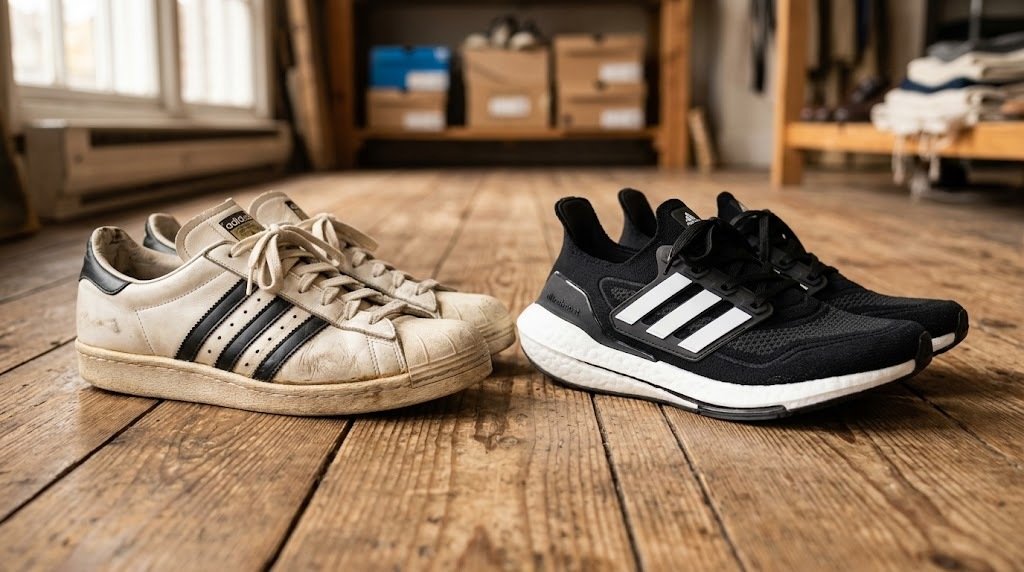
From football to streetwear
One particularly interesting example is the Samba.
The first Samba appeared in 1950 as a football shoe designed for icy and snowy surfaces. Over decades, the silhouette evolved from sports equipment into a major lifestyle sneaker.
That transition illustrates something important about adidas: a performance product can eventually become a cultural fashion product.
The same broader pattern can be seen across other adidas Originals models, where sporting heritage becomes part of everyday fashion.
What Are the Main Adidas Product Categories?
One reason adidas remains relevant across different audiences is its wide product architecture.
Adidas Originals
adidas Originals focuses heavily on lifestyle, heritage, and fashion.
Popular families include:
- Samba
- Gazelle
- Superstar
- Stan Smith
- Campus
- Handball Spezial
- SL 72
- Tokyo
- Spezial
- Forum
The current adidas catalog includes many of these collections, with Samba, Spezial, Superstar, Gazelle, Campus, and Stan Smith among its prominent Originals categories.
These shoes are generally associated with casual outfits, streetwear, retro styling, and everyday use.
Performance Adidas
Performance products are designed around specific sporting activities.
Examples include:
- Adizero for speed-focused running
- Ultraboost for running and sportswear
- Supernova for everyday running
- Predator for soccer
- F50 for soccer
- Anthony Edwards basketball footwear
- Dropset training shoes
- Terrex outdoor footwear
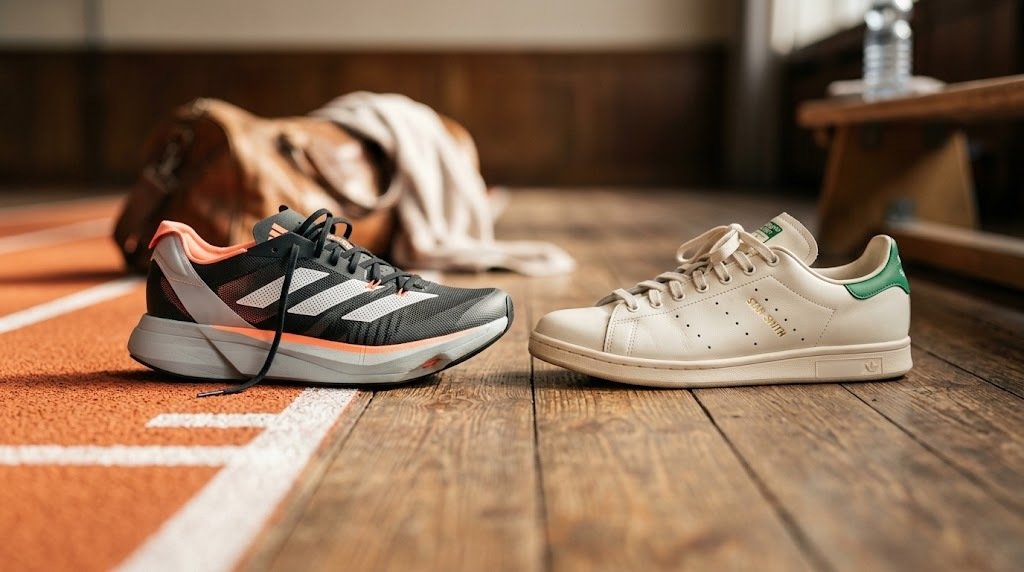
The distinction matters because a fashionable sneaker and a performance shoe are designed with different priorities.
A Samba may work well with jeans and casual clothing, while an Adizero running shoe is built around running-specific requirements.
Which Adidas Sneakers Are Iconic?
There is no single “best” Adidas sneaker for every person because different models serve different purposes. Instead, it is more useful to understand what each major family represents.
Samba
The Samba has one of the strongest links between adidas sports heritage and contemporary casual fashion. Its football origins and low-profile shape have helped make it a recognizable lifestyle silhouette.
Gazelle
The Gazelle is another classic low-profile sneaker associated with casual styling and the Originals category. It is available in numerous colorways and versions.
Superstar
The Superstar is known for its shell-toe design and long history in sportswear and street culture.
Stan Smith
The Stan Smith is one of adidas’s most recognizable minimalist sneakers. Its clean profile makes it particularly adaptable to casual wardrobes.
Campus
The Campus has a skate-inspired, retro appearance and is frequently used as part of relaxed streetwear outfits.
Handball Spezial
The Handball Spezial draws from adidas’s archive and has become another prominent low-profile lifestyle option.
A useful way to compare them: think about silhouette before thinking about color. A low-profile shoe changes the visual proportions of an outfit differently than a chunky running-inspired sneaker.
Nordstrom’s current adidas assortment illustrates how broad the lifestyle range has become, including Samba OG, Samba Jane, Tokyo, Gazelle Indoor, Campus 00s, Handball Spezial, Japan, and other footwear alongside apparel.
How Should You Choose adidas Sneakers?
The easiest mistake is choosing a sneaker because it looks good without considering how you will use it.
Use this simple four-step process.
1. Decide where you will wear them
For everyday casual use, consider lifestyle models from Originals.
For running, look at dedicated running families.
For soccer, basketball, training, or outdoor activities, start with footwear designed for that sport.
2. Identify the fit you want
Consider:
- Foot length
- Width
- Toe-box space
- Heel security
- Intended socks
- Whether you prefer a snug or relaxed feel
Sizing can vary by model, so checking the individual product’s size information is more useful than assuming every adidas sneaker will fit identically.
Famous Footwear similarly notes that many adidas shoes are generally true to size but recommends checking product-level information and customer feedback because individual styles can differ.
3. Match the shoe to your activity
A casual sneaker should not automatically be treated as a technical running shoe.
For example:
Daily walking: prioritize comfort, fit, and cushioning.
Running: look for running-specific construction and appropriate cushioning.
Gym training: consider stability and the movements you perform.
Soccer: choose footwear according to the playing surface and sport-specific requirements.
Streetwear: focus more heavily on silhouette, color, materials, and how the shoe works with your wardrobe.
4. Consider versatility
If you want one pair for multiple casual outfits, neutral colors such as white, black, gray, or understated combinations are often easier to style.
If your wardrobe already contains neutral clothing, a more noticeable colorway can become the focal point of an outfit.
Adidas Technology: Performance Beyond Style
The brand’s performance side is an important part of its identity.
The adidas US website currently highlights technologies and product families associated with running, training, and sports performance, including Boost cushioning and CLIMACOOL apparel technology.
Different technologies serve different purposes, so shoppers should avoid treating one technology as universally better than another.
For example:
- Boost: associated with responsive cushioning.
- CLIMACOOL: focused on cooling and moisture management.
- Adizero: associated with speed-oriented running products.
- Terrex: focused on outdoor activities.
- Predator/F50: designed around soccer performance.
The practical lesson is simple: start with the activity, then evaluate the technology.
Is Adidas Sustainable?
Sustainability is an increasingly important part of adidas’s product and supply-chain strategy, but it should be evaluated through specific measurable information rather than broad marketing language.
According to adidas’s 2025 reporting, 60% of the materials used for its products and packaging were recycled or sustainably sourced renewable materials. The company also reported that 99% of the polyester used in its products came from recycled content in 2025.
Its 2025 sustainability reporting also states that 43% of total material inflows were secondary, or recycled, materials.
The company reported a 9% reduction in product carbon intensity in 2025 compared with its 2022 baseline.
These figures provide useful context, but they do not mean every adidas product has identical environmental characteristics. Materials and manufacturing can vary by product.
For shoppers, the most useful approach is to check the specific product’s material information rather than assuming that a brand-wide sustainability figure applies equally to every shoe.
How Big Is Adidas in 2026?
The company remains a major global sportswear business.
According to adidas’s 2025 reporting, adidas generated €24.811 billion in net sales in 2025, while the company reported 64,938 employees worldwide.
The adidas brand’s footwear revenue increased 12% on a currency-neutral basis in 2025, while apparel increased 15%. Performance revenue increased 15% on a currency-neutral basis.
The company also reported strong growth across several categories, including Running, Football, Training, Basketball, Originals, and Sportswear.
These numbers help explain why adidas offers such a wide mixture of products. It is simultaneously operating in competitive sports, everyday athletic wear, fashion, and sneaker culture.
Adidas vs. Adidas Originals: What’s the Difference?
This is one of the most common points of confusion.
Adidas is the overall brand.
Adidas Originals is the lifestyle-focused label within the broader adidas brand ecosystem.
A simple example:
- Adizero running shoe: primarily performance-oriented.
- Predator soccer boot: sport-specific performance.
- Samba OG: lifestyle and heritage.
- Gazelle: lifestyle and casual fashion.
- Campus: lifestyle and streetwear.
The categories can overlap culturally, but their design priorities differ.
That distinction is especially useful when searching for adidas sneakers online. Instead of searching only for “adidas shoes,” identify whether you need running, training, soccer, basketball, outdoor, or lifestyle footwear first.
Why Adidas Remains Relevant to Fashion
The unusual strength of adidas is its ability to move between sports and fashion without completely abandoning its sporting identity.
A football shoe can inspire a lifestyle silhouette. A running technology can influence everyday footwear. A classic track jacket can become part of modern streetwear.
The current adidas US site reflects this combination: alongside sports categories, it actively promotes lifestyle collections and styling resources such as Samba outfit guides.
For fashion readers, this makes adidas particularly interesting because its archive is not separate from its current identity. Older designs continue to influence new releases and styling trends.
Frequently Asked Questions About Adidas
Is Adidas a German brand?
Yes. adidas was founded by Adolf “Adi” Dassler in Herzogenaurach, Germany. The modern adidas company was registered in 1949.
What are Adidas Originals?
Adidas Originals is the lifestyle and heritage-focused side of the brand, featuring well-known models such as Samba, Gazelle, Superstar, Stan Smith, Campus, and Handball Spezial.
Are Adidas sneakers good for everyday wear?
Many Adidas lifestyle sneakers are designed for casual everyday use. However, the appropriate choice depends on fit, comfort, walking needs, and the specific model.
What is Adidas known for?
Adidas is known for its three-stripe identity, sports footwear, performance technologies, Originals lifestyle products, and long-standing connection to football, running, basketball, and streetwear.
Are Adidas sneakers true to size?
Many models are generally designed around standard sizing, but fit can vary by silhouette. Checking the specific product’s size guide and customer feedback is recommended.
What should I look for when buying Adidas sneakers?
Start with purpose. Decide whether you need a lifestyle sneaker, running shoe, training shoe, soccer footwear, basketball shoe, or outdoor model. Then compare fit, cushioning, materials, durability, and styling.
Conclusion: Understanding Adidas in 2026
Adidas is more than the three stripes printed on a sneaker. Its identity comes from decades of athletic innovation, recognizable footwear, sports partnerships, lifestyle design, and a deep connection to sneaker and fashion culture.
Its current range spans everything from Samba, Gazelle, Superstar, and Campus lifestyle footwear to Adizero running shoes, Predator and F50 soccer products, training footwear, and outdoor equipment.
The best way to navigate that range is not to start with a specific model. Start with what you need the shoe to do, then consider fit, technology, materials, and style.
That approach makes it much easier to find the right adidas category without getting lost in hundreds of products.
Pingback: Advisory Board Crystals: Complete 2026 Style Guide