Andy Warhol changed the way people think about art, advertising, celebrity culture, and fashion. From colorful portraits of Marilyn Monroe to paintings of ordinary Campbell’s soup cans, Andy Warhol turned familiar images into works that challenged traditional ideas about creativity and originality.
Andy Warhol was an American artist, filmmaker, and leading figure in the Pop Art movement, best known for combining commercial imagery, celebrity portraits, bold colors, and repeated photographic images. His work blurred the boundaries between fine art and popular culture, influencing generations of artists, designers, photographers, and fashion brands.
Born Andrew Warhola in Pittsburgh, Pennsylvania, in 1928, he began his career as a commercial illustrator before becoming one of the most recognizable artists of the twentieth century. His distinctive visual language continues to appear in contemporary design, streetwear, magazine graphics, and fashion collections.
Understanding his work means looking beyond colorful pictures. Warhol explored consumerism, fame, mass production, and the relationship between public images and private identity. His legacy remains especially relevant in a culture shaped by social media, celebrity branding, and instantly recognizable visual trends.
Who Was Andy Warhol?
Andy Warhol was born on August 6, 1928, to immigrant parents Andrej and Julia Warhola. He grew up in a working-class neighborhood of Pittsburgh, where his early interests in drawing, popular entertainment, and visual culture helped shape his artistic direction.
As a child, Warhol experienced health difficulties, including a condition commonly described as Sydenham chorea. During periods when he was confined to bed, he spent time drawing, listening to the radio, and collecting images of celebrities. These early interests would later connect with his fascination with popular culture.
Warhol studied pictorial design at the Carnegie Institute of Technology, now Carnegie Mellon University, graduating in 1949. He then moved to New York City to pursue commercial art.
How Did Andy Warhol Become Famous?
During the 1950s, Warhol established himself as a successful commercial illustrator. He created advertising illustrations, fashion-related drawings, book graphics, and designs for well-known clients.
His commercial experience taught him how images attract attention, communicate quickly, and influence consumer behavior. Rather than abandoning advertising aesthetics when he entered the fine-art world, he made those aesthetics central to his artistic identity.
By the early 1960s, Warhol was producing paintings based on consumer products, comic imagery, and celebrities. His 1962 Campbell’s Soup Cans exhibition helped establish him as a major figure in Pop Art.
Warhol died in New York City on February 22, 1987, at age 58, following complications after gallbladder surgery.
What Is Andy Warhol Art Known For?
Andy Warhol art is recognized for its repeated imagery, vivid colors, commercial subjects, photographic source material, and references to American consumer culture. Instead of treating everyday products as ordinary objects, he presented them as subjects worthy of serious artistic attention.
His approach challenged the traditional distinction between high art and mass-produced imagery.
1. Campbell’s Soup Cans
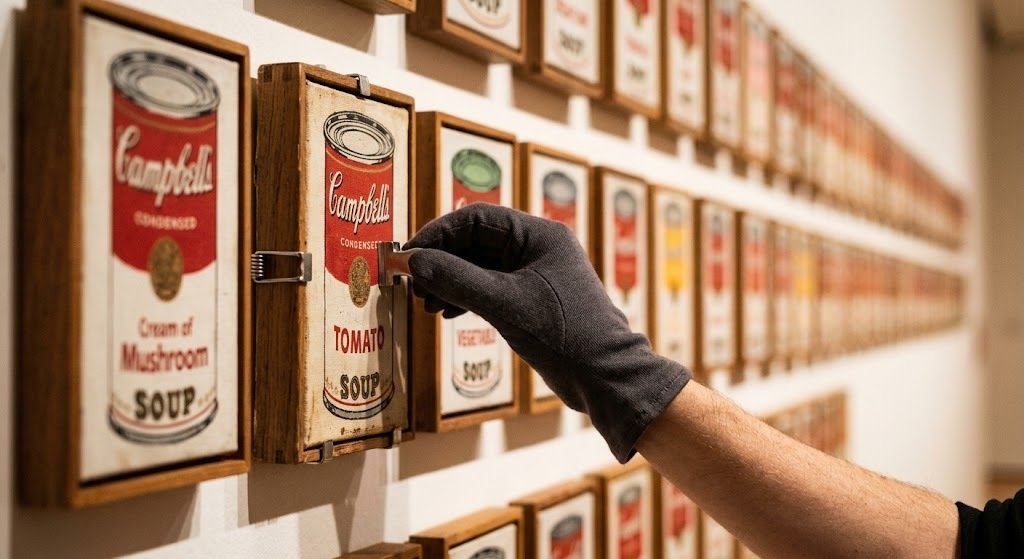
Warhol’s Campbell’s Soup Cans is one of the defining works of Pop Art. Created in 1962, the series consists of 32 canvases representing the soup varieties Campbell’s sold at the time.
The paintings resemble products displayed on grocery-store shelves. Their straightforward presentation deliberately echoes commercial packaging rather than traditional fine-art composition.
The series is often discussed as a statement about American consumer culture, but it also raises questions about familiarity and repetition. Why should a soup can be considered less worthy of artistic attention than a historical scene or a traditional portrait?
Warhol’s work challenges viewers to reconsider that distinction.
An important detail is that the original canvases were not simply mass-produced prints. Warhol painted them by hand, using a systematic process that included tracing and stamping elements of the design.
2. Marilyn Monroe Portraits

Following Marilyn Monroe’s death in 1962, Warhol created a series of portraits based on a publicity photograph of the actress. These works became among his most recognizable images.
Warhol repeated the same face in different colors, changing the mood and visual impact of each version. Bright pinks, yellows, blues, and contrasting backgrounds made the portraits visually striking.
The series explores the relationship between celebrity and image. Monroe was a real person, but the public often encountered her through carefully constructed photographs, films, and publicity campaigns.
By repeatedly reproducing her image, Warhol highlighted how fame can turn an individual into a widely circulated visual symbol. The portraits can appear glamorous, artificial, or unsettling depending on their colors and condition.
3. Elvis Presley and Other Celebrity Portraits
Warhol also created famous works featuring Elvis Presley, Elizabeth Taylor, Jackie Kennedy, and other public figures.
These portraits drew on photographs and media images rather than relying exclusively on traditional, direct observation. The approach connected portraiture with photography, publicity, and the growing influence of mass media.
His celebrity paintings are important because they show how public recognition can become part of an artwork’s meaning. A viewer’s understanding of the image often depends on already knowing the person depicted.
4. Flowers and Death and Disaster
Warhol’s subjects were not limited to celebrities and consumer goods.
His Flowers series transformed simple floral imagery into bold compositions, while his Death and Disaster works used newspaper photographs and other disturbing images to explore violence, tragedy, and the repetitive presentation of shocking events.
These contrasting subjects reveal a more complex artist than the familiar image of Warhol as a designer of cheerful, colorful pictures. His art could be playful and commercial, but it could also be dark, critical, and emotionally ambiguous.
What Artistic Techniques Did Andy Warhol Use?
Warhol’s style was closely connected to the methods of commercial printing and advertising. His techniques allowed him to repeat images while making deliberate choices about color, composition, scale, and presentation.
Screen Printing
Screen printing, particularly photographic silkscreen, became one of Warhol’s signature techniques.
The process transfers ink through a prepared screen onto a surface. When using photographic imagery, Warhol and his assistants could reproduce the same source image multiple times, often introducing changes in color or alignment.
The results were not always perfectly uniform. Misregistration, uneven ink, and other printing variations could remain visible, giving individual impressions their own character.
This technique suited Warhol’s interest in mass production. It also challenged the idea that an artwork must always be the product of a single, uninterrupted act of hand painting.
Repetition and Bold Color
Repetition is central to Andy Warhol art. A single image might appear several times in one composition or across an entire series.
Repeated images can become familiar, lose their initial impact, or acquire new meanings through comparison. Differences in color, cropping, and printing quality encourage viewers to examine details they might otherwise overlook.
His bold colors also reflect the visual language of advertising. Strong contrasts attract attention quickly, making his work recognizable even when reproduced at small sizes.
Photography, Film, and Multimedia
Warhol worked across painting, drawing, photography, printmaking, film, and other media. His experimental films include Sleep (1963) and Empire (1964), works that challenge conventional expectations about narrative, pacing, and entertainment.
He also made screen tests, recording people in extended portraits that reveal subtle changes in expression and movement.
His interdisciplinary practice demonstrates that his artistic interests extended well beyond paintings of soup cans and movie stars.
What Was The Factory, and Why Was It Important?
The Factory was Warhol’s famous New York studio and creative gathering place. It became associated with experimental art, filmmaking, music, performance, photography, and the city’s wider cultural scene.
Warhol worked with assistants and collaborators to produce artwork in a studio environment that differed from the traditional image of an isolated artist working alone.
The Factory also attracted actors, musicians, writers, models, and other personalities. Figures associated with Warhol’s circle included Edie Sedgwick, who became closely linked to his films and public image.
How Did The Factory Change Artmaking?
The studio reflected Warhol’s interest in collaboration and production. Assistants helped execute processes, prepare materials, and produce works under his direction.
This approach raised lasting questions about authorship. If an artist designs an image and directs a production process involving several people, how should individual creative contributions be understood?
Warhol’s practice made those questions especially visible. It also anticipated aspects of contemporary creative industries, where designers, photographers, production teams, and brand strategists collaborate to create a consistent visual identity.
How Did Andy Warhol Influence Fashion and Streetwear?
Warhol’s impact extends beyond museums and galleries. His use of recognizable imagery, repetition, graphic contrast, and commercial references connects naturally with fashion, streetwear, and branding.
Fashion communicates through visual symbols. A logo, a print, or a familiar image can signal identity before a viewer knows anything about the person wearing it. Warhol understood the cultural power of such images long before social media made them ubiquitous.
Graphic T-Shirts and Pop Art Prints
Warhol’s visual language translates effectively onto clothing because it is bold, recognizable, and adaptable to different sizes.
Graphic T-shirts, sweatshirts, and accessories can incorporate Pop Art-inspired portraits, repeated product imagery, or bright color combinations. These designs can make an outfit feel expressive without requiring complicated styling.
For an everyday outfit, a colorful graphic tee can work with straight-leg jeans and simple sneakers. A more restrained design can be paired with a neutral jacket and trousers, allowing the artwork to remain the focal point.
These are contemporary styling applications of Pop Art aesthetics, not claims that every such garment was designed by Warhol himself.
Celebrity Culture and Fashion Branding
Warhol’s celebrity portraits offer another connection to fashion. Both celebrity culture and fashion rely on photography, publicity, recognizable identities, and carefully managed public images.
Modern campaigns frequently circulate the same image across billboards, magazines, websites, social platforms, and retail displays. Warhol’s repeated compositions offer a useful historical comparison for understanding how images become familiar through constant exposure.
His work also encourages a critical question: when a person’s image is reproduced endlessly, does it strengthen their identity, turn them into a commercial symbol, or do both at once?
Pop Art in Contemporary Streetwear
Streetwear often draws from music, art, sports, subcultures, and popular entertainment. Pop Art fits naturally into this environment because it transforms familiar cultural references into graphic statements.
When evaluating Pop Art-inspired clothing, look at three things:
- Image choice: Is the design built around a recognizable portrait, product, or symbol?
- Color and composition: Do strong contrasts and repeated graphics create visual impact?
- Authenticity: Is the garment an officially licensed collaboration, a documented archival design, or simply a modern piece inspired by Pop Art?
That final distinction matters. A shirt featuring a Warhol-style portrait is not automatically an authentic Andy Warhol product. Check the label, licensing information, seller documentation, and provenance before assuming a direct connection to the artist.
Why Is Andy Warhol Still Relevant Today?
Warhol remains relevant because the issues he explored are deeply connected to modern life: celebrity, consumerism, repetition, branding, and the circulation of images.
Social media users encounter the same photographs, promotional graphics, and celebrity stories across multiple platforms. Brands also rely on consistent visual identities to make their products instantly recognizable.
Warhol’s work provides a way to examine these patterns rather than simply accept them.
An Original Way to Read His Work
Consider a modern product campaign featuring one sneaker photographed in five colorways and distributed across a brand’s website, social media, and advertising.
A Warhol-inspired reading would ask more than whether the images look attractive. It would examine why the same product is repeated, how color changes perception, and how repetition turns an ordinary object into a symbol of desire or status.
This is a contemporary interpretive example, not a historical event or a documented Warhol experiment. It illustrates why his visual methods remain useful for analyzing advertising and fashion today.
Where Can You Learn More About Andy Warhol?
For reliable information, begin with museum collections and organizations responsible for preserving his work.
- The Andy Warhol Museum: Explore the artist’s biography, collection, archival materials, and exhibitions.
- The Museum of Modern Art (MoMA): Read about Warhol’s works and the history of Campbell’s Soup Cans.
- The Andy Warhol Foundation for the Visual Arts: Learn about its grants, legacy projects, and scholarly research.
These sources provide a stronger foundation than unattributed social media posts, particularly when researching dates, artwork titles, techniques, and authenticity.
Conclusion: The Lasting Legacy of Andy Warhol
Andy Warhol transformed ordinary products, famous faces, and mass-media images into art that continues to challenge conventional ideas about creativity. His work helped establish Pop Art as a major force in modern culture, while his use of repetition, screen printing, photography, and collaboration expanded the possibilities of artistic production.
His influence can still be seen in graphic design, advertising, fashion, and streetwear. More importantly, his work encourages viewers to think critically about how images shape identity, consumer behavior, and public attention.
Whether you are exploring his famous paintings for the first time or studying his influence on contemporary style, Andy Warhol offers a compelling way to understand the relationship between art and everyday life.
Explore more fashion history, influential designers, and cultural trends through our related guides.
Frequently Asked Questions About Andy Warhol
Who was Andy Warhol?
Andy Warhol was an American artist, filmmaker, and leading figure in the Pop Art movement. He became famous for colorful celebrity portraits, Campbell’s Soup Cans, and artwork inspired by consumer culture and mass media.
What is Andy Warhol most famous for?
He is best known for Campbell’s Soup Cans, his Marilyn Monroe portraits, and his use of repeated photographic images and bold colors. These works helped redefine the relationship between commercial imagery and fine art.
What is Andy Warhol art?
Andy Warhol art refers to paintings, prints, photographs, films, and other works that explore popular culture, consumer products, celebrity, and mass media. His work frequently uses repetition, photographic imagery, and commercial printing techniques.
Why did Andy Warhol paint Campbell’s soup cans?
Warhol used Campbell’s soup cans to explore familiar consumer products as subjects for fine art. The series challenged conventional distinctions between ordinary commercial objects and traditionally celebrated artistic subjects.
How did Andy Warhol influence fashion?
Warhol influenced fashion through his use of celebrity imagery, bold graphics, repetition, and commercial visual language. These ideas remain relevant to graphic clothing, fashion advertising, and contemporary streetwear.
Where can you see Andy Warhol’s artwork?
You can explore his work through The Andy Warhol Museum in Pittsburgh, the Museum of Modern Art in New York, and other museums with Warhol collections. Check each institution’s website for current exhibitions and availability.